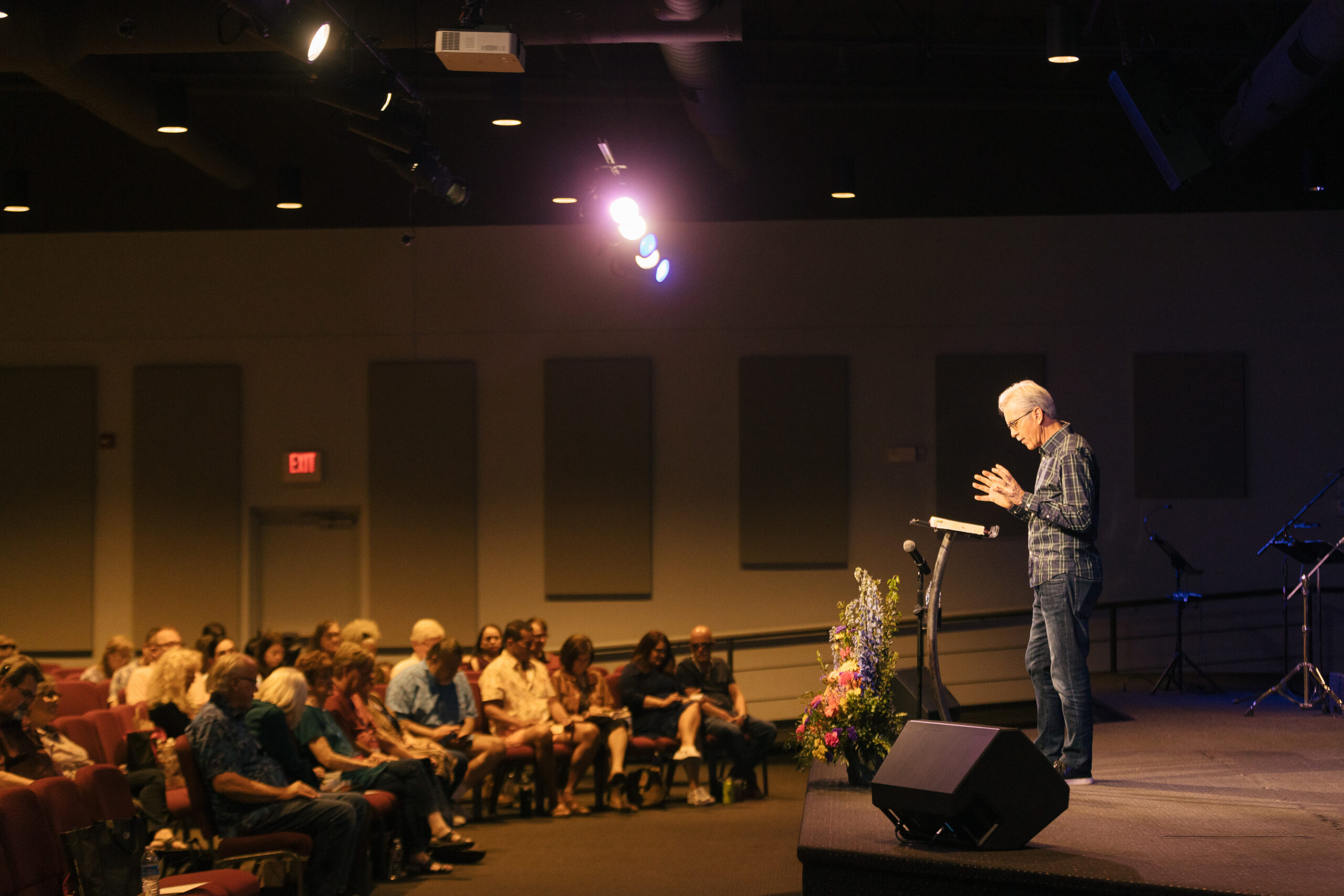
Last Sunday, Ociel, one of our leaders, continued the series Empowered for Purpose with a message titled “Awakened to True Identity.”
Over the past several weeks, we have been exploring what it means to be empowered for purpose. We often teach in a series because some biblical truths are too expansive to unpack in a single message. They require time, repetition, reflection, and application.
Two central themes have guided this series: identity and empowerment.
Our identity is rooted in Christ.
It is not rooted in our mistakes, defined by our failures, or determined by others’ opinions. Having an identity in God means that our deepest worth and sense of self are defined by our relationship with Him.
Consider the significance of that truth. The God of creation—the eternal, omnipotent, omnipresent, and perfect God—created you. David writes:
“For You formed my inward parts;
You covered me in my mother’s womb.”
—Psalm 139:13 NKJV
God was actively involved in forming you. He was involved not only in your physical development but also in the purpose, gifts, capacities, and personality He placed within you. The Creator of the universe ultimately defines your identity.
That is why we must become acquainted with Scripture. We need to know what God says about us. He calls us a holy nation and a people set apart for Himself. Scripture uses the tender expression that His people are the “apple of His eye.”
Through Isaiah, God describes the extraordinary value He places on His people:
“Since you were precious in My sight,
You have been honored,
And I have loved you;
Therefore, I will give men for you,
And people for your life.”
—Isaiah 43:4 NKJV
You are precious to God, deeply loved and highly valued.
When circumstances, culture, disappointment, or the voices around us cause us to forget who we are, we must return to this foundational truth: God defines me.
Being empowered by God means receiving His strength, guidance, and courage to accomplish what we could never do on our own. Life is too difficult to live by human strength alone. We need a source greater than ourselves. God is that source.
He defines our identity, supplies our strength, and empowers us to fulfill His purposes. Your true identity is defined not by your failures but by your union with Christ.
Adopted but Still Thinking Like an Orphan
Imagine a child who has been legally adopted into a loving family. The adoption is complete. The child belongs to the family, bears the family name, lives in the family home, and has access to everything the family provides.
Yet the child may still feel like an orphan. He may hide food because he fears there will not be enough tomorrow. He may resist affection because he has learned not to trust anyone. He may feel he must earn his place in the home, even though the adoption papers have already declared that he belongs.
Legally, he is a son. Emotionally and mentally, he may still feel abandoned.
The same can happen to believers. We can belong to Christ while still thinking in terms of our old nature. We have been adopted into God’s family, made alive in Christ, and given a new identity, yet we may still think like spiritual orphans.
God’s Spirit and Word work within us to conform us to the image of Christ and to awaken us to who we already are in Him. Our lives have been shaped by God’s eternal design and purpose. That design is woven into each of us.
Yet our true purpose is often obscured by weakness, mistakes, wounds, and failures. In Christ, however, the old nature has been rendered powerless, and the new nature has been set free.
As we learn to live our new life in Jesus, our true identity begins to surface. We start living according to God’s eternal design.
There are no super saints in church history. Only ordinary men and women choose to surrender, follow, and obey the Lord. Peter was one of them.
Surrender to Christ is the path to transformation and the fulfillment of destiny. Every obstacle we overcome strengthens us and brings us closer to God’s purposes. God can even take what the enemy intended for destruction and use it to position us for destiny.
One of the most repeated commands in Scripture is “Fear not.” When we refuse to fear, we allow faith to flourish.
Confident faith is not controlled by fear. It rests in the goodness and faithfulness of God, even amid adversity.
When a Lost Job Becomes an Identity Crisis
A few years ago, during the COVID-19 pandemic, my assistant, Ociel, lost his job. It was the first time he had ever been let go from a position.
He loved the job. He loved the organization and the work they did. They launched projects, built programs, developed people, and accomplished meaningful work. He believed he would remain there for a very long time.
But the organization and he eventually moved in different directions. There was nothing immoral or scandalous about it. The organization had one vision for the future, while he sensed a different direction emerging in his life.
When he received the call to come in and was told he was being let go, he was completely unprepared. His heart sank. He said it felt as though everything had suddenly fallen apart.
He began thinking, “I am a husband. I am a father. I am a provider. What am I going to do now?”
The uncertainty was compounded by the instability of the COVID era. For months, he wrestled with why it had happened. He began questioning his identity, his calling, and even the gifts God had placed within him. It became something of an existential crisis.
Many people understand that feeling. Perhaps you have lost a job, a relationship, a position, an opportunity, or something else central to your sense of self. When something important is taken away, it can leave you feeling lost at sea.
Pastor and author John Mark Comer has observed that the question is not whether we are being discipled, but who or what is discipling us. In difficult seasons, we must ask: Whose voice is filling our hearts and shaping our thoughts?
During that season, he realized he had misplaced his identity. His identity had become intertwined with his job rather than rooted in his relationship with God.
This can happen at any point in the Christian life. We lose sight of who we are, and God lovingly calls us back to Christ. One reason Scripture is so powerful is that it does not hide the failures of its central characters.
David was Israel’s beloved king and a man after God’s own heart, yet he committed adultery and arranged another man’s death. Abraham, Noah, Moses, and many others had complicated stories and significant failures.
The Bible records both the highs and the lows. That honesty makes its message deeply relatable. Scripture shows us that God works through imperfect people. Peter is one of the clearest examples.
Peter Was Restored to His True Identity
Peter was a fisherman by trade. Fishing was his occupation and, in many ways, his identity. Then Jesus called him to leave his nets and become a disciple.
For about three and a half years, Peter lived under Jesus’ teaching. He witnessed miracles, healings, deliverances, and extraordinary demonstrations of God’s kingdom. His life became an adventure of faith. Peter loved Jesus deeply.
Yet on one of the darkest nights in human history, Peter abandoned the One he loved most dearly.
Only hours earlier, Peter had confidently declared he would never leave Jesus. But when Jesus was arrested and taken away, fear settled in Peter’s heart. He denied knowing Jesus. He denied being His disciple. He even cursed and swore that he had no association with Him.
Peter’s failure was public, painful, and deeply devastating.
After the crucifixion and resurrection, Peter and several other disciples returned to the sea to fish. In a moment of disappointment and uncertainty, they returned to what they had known before Jesus called them.
Isn’t that often what people do?
When something earthshattering happens—a lost relationship, a job loss, an illness, a betrayal, or a severe disappointment—we instinctively revert to familiar patterns. We try to regain control by returning to what we know.
Peter went back to the boats and nets.
Then Jesus appeared on the shore. He instructed the disciples to cast their net on the other side of the boat. When they obeyed, they caught an enormous number of fish. Recognizing the Lord, they came ashore and ate with Him.
Imagine how Peter must have felt. The other disciples were undoubtedly overjoyed to see Jesus, but Peter may have stood at a slight distance, unsure how to approach Him. He had denied Jesus three times and failed at the moment when loyalty mattered most.
Yet Jesus neither humiliated, condemned, nor scolded Peter.
John records their conversation:
“So when they had eaten breakfast, Jesus said to Simon Peter, ‘Simon, son of Jonah, do you love Me more than these?’” He said to Him, ‘Yes, Lord; You know that I love You.’
He said to him, ‘Feed My lambs.’”
—John 21:15 NKJV
Jesus asked him a second time:
“‘Simon, son of Jonah, do you love Me?’
He said to Him, ‘Yes, Lord; You know that I love You.’
He said to him, ‘Tend My sheep.’”
—John 21:16 NKJV
Then Jesus asked a third time:
“‘Simon, son of Jonah, do you love Me?’ Peter was grieved because He said to him the third time, ‘Do you love Me?’ And he said to Him, ‘Lord, You know all things; You know that I love You.’
Jesus said to him, ‘Feed My sheep.’”
—John 21:17 NKJV
Peter had denied Jesus three times, and Jesus gave him three chances to reaffirm his love. Jesus did not lash out at Peter. He did not say, “I thought you were different,” or “You disappointed Me when I needed you most.” Instead, Jesus restored Peter to relationship.
Jesus forgives, and Jesus restores.
Before Jesus emphasized Peter’s assignment, He restored their relationship. Peter needed reconciliation. He needed to know that failure had not severed his relationship with the love of Christ.
Then Jesus restored Peter to ministry and purpose: “Feed My sheep.” Jesus did not merely forgive Peter’s past. He called forth Peter’s future.
Restoration is not only about removing shame but also about releasing the assignment.
Peter’s destiny was to become a leading apostle and a builder of the early church. That purpose was in God’s heart before Peter was born. Life’s circumstances and Peter’s own choices had temporarily concealed his true identity from him, but they had not erased God’s purpose.
Peter was no longer merely Simon, the wavering one. He was Peter, the steadfast rock. He had a new nature, a new identity, and an assignment, empowered by God’s Word and Spirit.
God does the same for us. We have moments when we miss the mark and fail, yet Jesus continually calls us back into relationship. His gifts and callings are irrevocable. His grace is extravagant.
He does not merely remove your shame; He calls forth your future.
Pentecost Revealed Peter’s Identity in Action
Approximately fifty days after Peter’s restoration, the day of Pentecost arrived. Acts 2 describes the disciples gathered together in one place when the Holy Spirit came upon them.
They were filled with the presence and power of God and began speaking other languages as the Spirit enabled them. A crowd assembled in Jerusalem, both puzzled and astonished by the events unfolding.
Then Luke records a significant moment:
“But Peter, standing up with the eleven, raised his voice and said to them…”
—Acts 2:14 NKJV
Peter stood up.
The man who had once been intimidated by a servant girl’s questions now stood before a massive crowd in Jerusalem. The timid fisherman proclaimed the gospel with fierce, unapologetic authority.
He preached Christ crucified and risen. His words pierced the hearts of the listeners, and about three thousand people were saved that day. Peter moved from being a passive spectator to becoming the tip of the spear in the early church.
Boldness replaced fear. Authority replaced insecurity. Purpose replaced shame.
Pentecost did not create Peter’s calling; it awakened and empowered it.
Peter had already received the calling, and Jesus had already spoken life over him. The Holy Spirit gave Peter the strength and courage to step into everything that God had prepared for him.
The evidence of transformation was unmistakable. Peter was no longer acting in his former identity. His gifts and calling had been activated.
Where does fear need to be replaced with boldness in your life? Where does insecurity need to give way to spiritual authority?
When God fills our hearts, we are empowered with courage, boldness, and authority.
Alive to God Through Christ
When we are born again, we enter into union with Christ. God not only renders the old nature powerless; He also ceases to define us by our past.
The Holy Spirit speaks to who we are now in Christ. He reveals our relationship with the Father and awakens us to our new identity.
Paul writes:
“So you also should consider yourselves to be dead to the power of sin and alive to God through Christ Jesus.”
—Romans 6:11 NLT
John echoes this reality:
“We know that we have passed from death to life, because we love the brethren.”
—1 John 3:14 NKJV
We have passed from death into life.
The very life of God has entered us. It is resurrection life—life that death cannot overcome. We no longer live by the old life or the old nature. We live by Christ’s life within us.
His perfected love casts out fear. You are loved and accepted by the Father and restored by the work of Christ. As you faithfully walk with Jesus, you can trust that God is working all things together for good.
Your prayers are heard. Your life matters. Your Father is good.
Seated with Christ
Paul gives us another extraordinary picture of our identity in Christ:
“But because of his great love for us, God, who is rich in mercy, made us alive with Christ even when we were dead in transgressions—it is by grace you have been saved. And God raised us up with Christ and seated us with him in the heavenly realms in Christ Jesus.”
—Ephesians 2:4–6 NIV
Because of His great love, God made us alive with Christ, raised us with Christ, and seated us with Christ in the heavenly places.
This is not merely poetic language. It describes our relational and spiritual position.
We have been raised with Christ into newness of life. We now live from His identity and His victory. We have been made alive together with Him and raised to His authority.
When this truth becomes more than a theological talking point, we begin to live with greater confidence. We become a light in dark places. But when we continue to see ourselves through the lens of our old nature, we struggle to receive by faith what God has already made available.
A person can be physically out of Egypt while still carrying Egypt within. Deliverance from bondage must be accompanied by a renewal of identity.
Activate the Gifts God Has Given You
One way we move from fear to boldness is by becoming willing to act.
The Christian life is one of faith. God gives promises, direction, and empowerment, but He does not do everything for us.
He chooses to partner with us. That partnership requires initiative, desire, obedience, and a step of faith. To activate the gifts God has placed in your life, you must be willing to act.
Each person has unique strengths, abilities, capacities, and gifts. Consider what God has enabled you to accomplish.
Some people have a gift for hospitality. When others enter their home or presence, they immediately feel welcome and cared for. That is an important gift in a lonely and disconnected world.
Some have an organizational gift. They can look at confusion and immediately see how people, systems, and resources can be arranged effectively and efficiently.
Others possess a teaching gift. They may lack formal credentials, but they have a God-given ability to communicate ideas clearly, encourage others, and make complex truths understandable.
Some are artists and musicians. Through their creativity, they reveal dimensions of God’s beauty and of the world around us that others might never have noticed.
What gifts has God placed within you?
What can you do particularly well? What strengths do you have that others may not possess in the same way?
To activate those gifts, begin by looking at the opportunities and needs around you. Ask where what you carry can begin to serve others.
Often, we hesitate because we fear failure. We worry that things may not go well or that others may not embrace what we offer. But when we take a step of faith, God goes with us. He has empowered us.
Giftedness Is a Privilege
Once a gift is activated, the original excitement will eventually fade. What once felt exhilarating may begin to feel ordinary, difficult, or tiresome.
The posture that sustains our gifting is learning to view it as a privilege rather than merely an obligation.
It is a privilege to teach God’s Word. It is a privilege to welcome people, greet them, and help them feel seen. It is a privilege to serve others through our work. It is a privilege to strengthen an organization, care for a family, lead a team, create beauty, or help someone in need.
When we view our gifts as privileges, our perspective shifts. Service becomes sustainable.
Our background, history, and current circumstances do not have the final say. Because God is with us, we can take responsibility for our lives, exercise initiative, and step into His purposes.
Breaking the Grasshopper Mindset
Numbers 13 tells the story of Israel standing at the edge of the land God had promised them.
Moses sent twelve leaders—one from each tribe—to explore Canaan. For forty days, they examined the land. When they returned, they brought back evidence that it was rich, fruitful, and abundant.
But ten of the spies focused on the strength of the inhabitants and the cities’ fortifications. They concluded that taking the land was impossible.
Caleb saw the same obstacles but reached a different conclusion:
“Let us go up at once and take possession, for we are well able to overcome it.”
—Numbers 13:30 NKJV
God had already promised Israel the land, but He required them to partner with Him. The reconnaissance mission was not meant to determine whether God’s promise was true. It was meant to prepare them to possess what He had promised.
Ten spies returned in fear, but Joshua and Caleb returned in faith.
The ten reported:
“There we saw the giants…and we were like grasshoppers in our own sight, and so we were in their sight.”
—Numbers 13:33 NKJV
At the surface level, the problem was fear and unbelief. At a deeper level, however, their problem was a false identity.
They still saw themselves as slaves.
God had delivered them from Egypt, led them through the wilderness, fed them miraculously, and repeatedly demonstrated His power. Yet Egypt remained in their thinking.
Slaves do not possess land. Slaves do not see themselves as having rights, authority, or inheritance. Although their bodies had been delivered from Egypt, their minds had not yet been delivered from slavery.
Joshua and Caleb had a different spirit. They saw themselves as covenant people carrying God’s promise. The giants were real, but God’s promise was greater. The obstacles were merely speed bumps on the road to their fulfilled destiny.
The other ten allowed human reasoning to deny faith the opportunity to lead them.
The result was tragic. An entire generation, except for Joshua and Caleb, wandered in the wilderness and died. The inheritance God intended for them was passed to another generation.
Simply put, slaves do not win battles. Those who possess an inheritance must have renewed minds and a God-shaped identity.
“For as he thinks in his heart, so is he.”
—Proverbs 23:7 NKJV
Where have you allowed old patterns of thinking to return?
We can be filled with faith, authority, and power, yet gradually allow the mentality of Egypt to creep back into our thinking. This is why it matters which voices inform us.
A reliable sign that a voice is not the voice of God is that it continually minimizes you, condemns you, tells you that you are unworthy, or insists that your time has passed.
God’s voice does not lead you back into slavery.
The enemy says, “You are incapable. You are not intelligent enough. You are not educated enough. You will fail. You should stay where you are.”
God says He has plans to give you hope and a future. He also says you can do all things through Christ, who strengthens you. One voice minimizes you; the other invites you into partnership.
Silencing the Voice of Egypt
Ociel’s brother died when he was seventeen years old. He was twenty-four. He had been the middle child, but after his death, he became the oldest surviving child.
During that painful season, a family friend approached him. She was someone he believed loved him and cared about his family.
She told him, “You are not going to fill your brother’s shoes.”
Then she continued: “The truth is, you are not going to amount to anything. You are not going to be as good as he was. You are simply going to have to settle in life.”
He was seventeen years old.
Those words became the voice of Egypt in his life. They became the voice of slavery.
For years, that voice spoke to him. When opportunities for promotion arose at work, he stepped back. He thought, I cannot do that. I will fail. I was already told that I would never amount to anything.
The thought planted in his mind became a belief in his heart. That belief began controlling his decisions. He believed he was incapable, and that belief prevented him from fully engaging with life.
Many people are living under similar circumstances. Someone spoke over you, minimizing your value, attacking your potential, or distorting your identity. Perhaps it came from a parent, teacher, employer, friend, or trusted authority figure.
It is time to silence those beliefs and return to what God says about you.
You are more than a conqueror through Christ.
You have the mind of Christ.
You are alive to God.
You are seated with Christ.
You are loved by the Father.
You are not a grasshopper.
Consider these questions:
• Where do you still see yourself as small or inadequate?
• Where do you still see yourself as a grasshopper?
• What promise has fear kept you from claiming?
• What inheritance might await on the other side of renewed identity?
Peter shows us what happens when identity is restored. Israel in Numbers 13 shows us what happens when identity remains unrenewed.
As children of God, we must continually return to what God says about us. Our old self has been crucified with Christ and rendered powerless, including carnal reasoning and thought patterns that contradict heaven’s perspective.
You are affected by what you believe. You have the mind of Christ—agree with that.
Through the Holy Spirit, we are empowered to become what we could never be apart from God. We move from broken sinners to beloved saints. No matter what lies behind us, there is hope.
Prophetic Identity Propels Purpose
When Jesus told Peter, “Feed My sheep,” He gave Peter a word to stand on.
That word empowered him. Peter now had a clear declaration from Jesus that he would shepherd God’s people. When fear tried to return, Peter could lean on what Christ had spoken. He could move forward confidently as the Spirit led him.
Peter was becoming what Jesus had prophesied he would become.
When God gives us a word about identity or destiny, He reveals what He sees and what He has determined. He also gives us permission to see ourselves from His perspective.
God’s Spirit-breathed Word propels us toward purpose.
Prophecy is not merely about survival. It empowers us to overcome and prosper in God’s purposes because we have received the Word of the Lord.
We must exchange an earthly mindset for a heavenly one. Our citizenship is in heaven. Our identity is not determined by the world’s fluctuating circumstances.
After Pentecost, Peter stood with the eleven, raised his voice, and preached with authority. Thousands came to Christ. Peter had awakened to his true identity as the steadfast rock, and that identity empowered him to step into his destiny.
God’s Word propels purpose.
The only way to uproot a destructive belief is to replace it with truth. We must identify the old thoughts that keep us from moving forward and intentionally replace them with what God has spoken.
Perhaps this means pursuing a promotion you have been afraid to accept. Perhaps it means launching a business or creative venture. It could also mean having a necessary conversation with your employer about compensation, responsibilities, or unfair treatment.
Fear often keeps us from taking bold steps. But God has not called us to live under the weight of thoughts that contradict His Word.
Paul writes:
“For God has not given us a spirit of fear, but of power and of love and of a sound mind.”
—2 Timothy 1:7 NKJV
Not every thought that enters your mind is one you must accept.
We all experience fear, but fear is not our identity. God has not given us a spirit of fear. He has given us power, including spiritual authority. He has given us love, which overcomes hostility, rejection, and division. He has given us a sound mind—the ability to think, process, analyze, exercise wisdom, and gain insight.
You are empowered.
Scripture also declares:
“Be strong and of good courage, do not fear nor be afraid of them; for the LORD your God, He is the One who goes with you. He will not leave you nor forsake you.”
—Deuteronomy 31:6 NKJV
God asks us to be courageous because faith requires courage.
God may reveal what He has promised, but possessing the promise requires a willingness to act. It demands courage, boldness, and fortitude.
Where do you need to step forward today? Where do you need to act courageously, even if you feel nervous or anxious?
John Wayne famously described courage as being scared to death, yet saddling up anyway. Where do you need to saddle up?
God is with you. He empowers, guides, protects, encourages, and fathers you. Through Christ, you can do all things He has called you to do.
Awaken to Who God Says You Are
My prayer is that you will awaken to God’s identity and to the calling over your life.
You are unique. God has given you a calling and placed gifts, strengths, and capacities within you. Awaken to that identity.
We honor our God-given identity by allowing ourselves to be defined by what He says, activating our gifts, living intentionally, and letting His Word propel us toward destiny.
Take a step of faith.
Return to your God-given identity. Live a meaningful life of intention and purpose. Let the Holy Spirit awaken what God has placed within you.
Ask yourself:
• What has God called you to do that you have not yet believed?
• What earthly perspective must yield to heaven’s perspective?
• Are you ready to stand up, raise your voice, and live as your true self?
This week, write down one prophetic word, Scripture, or promise God has spoken over your life. Place it where it is visible. Read it aloud each morning and thank God that He is the One bringing it to pass.
Just as Jesus restored Peter, God is calling you out of shame and into a relationship. He is calling you out of fear and into courage. He is calling you out of old ways of thinking and into renewed identity.
Pentecost did not create Peter’s calling. It awakened and empowered what God had already placed within him.
May the same Holy Spirit awaken you.
May God’s Word and Spirit guide you. May you rise with confidence, embrace your purpose, and passionately advance God’s kingdom on earth.
Your true identity is not defined by your failures.
It is defined by your union with Christ.