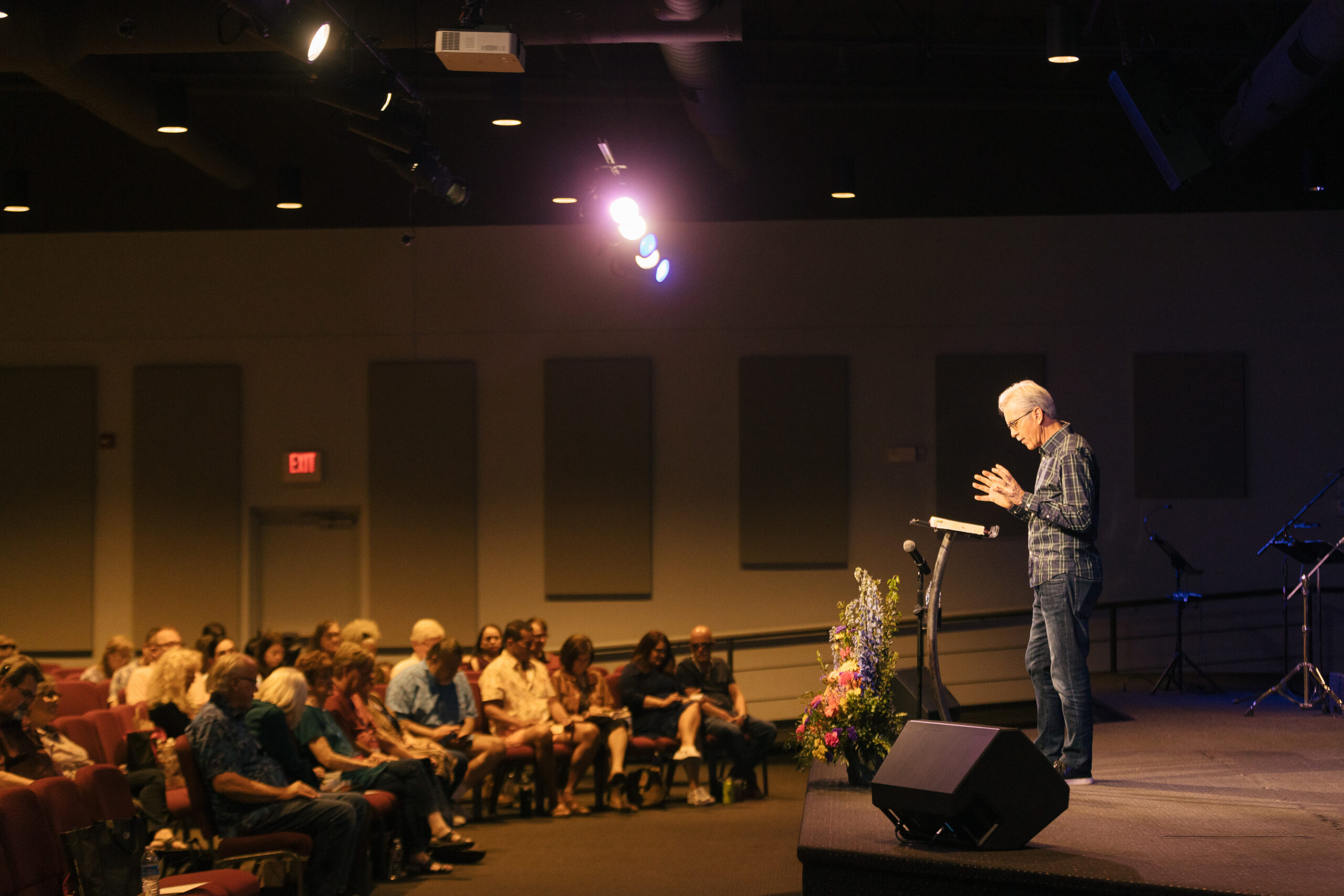
Hearing God begins with the daily choice to sit at the feet of Jesus and listen.
Today I’m launching a new series on hearing God. Over the next several weeks, we will explore whether God still speaks today, how we recognize His voice, and how we discern His will. Faith grows as we learn to hear Him.
Many of us need a fresh word from the Lord in this season. We face decisions, uncertainty, family needs, health concerns, and questions about purpose. The answer to every specific question isn’t found on page 637, or any other page, of our Bible. Scripture is foundational, and God often highlights a passage at exactly the right moment. He also gives impressions through the Holy Spirit, and we need to learn to notice what He is communicating.
To hear God is to experience Him. As we learn to recognize His voice, He no longer seems like a distant Creator who may or may not be involved in our lives. He becomes wonderfully real. Our faith becomes more than a set of beliefs about Him; it becomes a relationship with the living God. David said, “My heart and my flesh cry out for the living God” (Psalm 84:2). Jesus is risen, present, and involved in our lives. In Him we live, move, and have our being (Acts 17:28). He wants us to know Him, hear Him, and experience Him.
The One Essential Thing
Luke 10:38–42 recounts the familiar story of Mary and Martha. Martha welcomed Jesus into her home and served Him. Mary sat at His feet and listened to His word. Martha became distracted by everything that needed to be done, so she asked Jesus to tell Mary to help her.
Jesus replied, “Martha, Martha, you are worried and troubled about many things. But one thing is needed, and Mary has chosen that good part, which will not be taken away from her” (verses 41–42). The Message Bible paraphrases His words, “One thing only is essential.”
Mary quieted herself, drew near, and listened. She was not merely receiving instruction; she was relating to Jesus and communing with Him. Hearing God begins there. Prayer is a two-way conversation. We bring our needs and petitions to God, but we also wait, listen, and respond.
Martha was doing something good. Jesus did not condemn service. He calls us to love and serve one another, and some of our closest relationships with God and other believers develop as we serve together. The problem was that Martha’s service had displaced her peace. Activity had turned into anxiety, and she had lost sight of the Person she was serving. When we do many things for the Lord but neglect time with the Lord, our priorities get out of order.
Jesus is the vine, and we are the branches (John 15:5). We cannot live well apart from Him. An old Martin Smith worship song, “This Is the Air I Breathe,” captures that dependence. His presence is the air we breathe. He is the reason we live. None of us is a perfect Christian, but the Perfect One lives within us and invites us into daily communion.
Many resources can help us grow: Bible studies, apps, courses, commentaries, seminaries, and printed Bibles. Use them. Read your Bible. Yet none of these can replace a close relationship with Jesus.
What is distracting you from sitting with Him? What excuses have quietly taken over your schedule? What would ten quiet minutes with Jesus look like before the day’s pressures of family, children, work, and responsibilities begin? The adjustment may be simpler than you think.
Jesus Lived from the Initiative of the Father
Jesus showed us how to live in continual relationship with Father God. He did not act on His own initiative. He acted as He saw the Father working and spoke what He heard the Father say. John 5:19–20 and 30 describe this remarkable life of dependence.
“So Jesus explained, ‘I tell you the truth, the Son can do nothing by himself. He does only what he sees the Father doing. Whatever the Father does, the Son also does.’” John 5:19 NLT
That is an astounding statement. Jesus saw what the Father was doing and responded to Him. The language of seeing is important because God often communicates through pictures, dreams, and visions. We live in a generation captivated by video. People can scroll from one short video to the next, including an apparently endless supply of cat reels!
If images communicate so powerfully in ordinary life, we should not be surprised when God brings a picture to mind by His Spirit. God is not producing social-media reels in heaven, but He does use visual language.
Jesus also revealed the Father’s character. Some imagine God as distant and angry, yet Jesus is the exact representation of the Father. He said that anyone who had seen Him had seen the Father. Jesus welcomed those the religious crowd rejected. He ate with those they called unclean, forgave sinners, healed the sick, and raised the dead. He confronted religious unbelief, yet consistently revealed a Father who loves people. Everything Jesus did flowed from what He saw the Father doing.
Can you and I live by that kind of divine initiative? I believe we can learn to hear God in ways that help us respond to His leading. We will not hear or communicate with Him the same way, and no formula eliminates the need for relationship. The Holy Spirit, who inspired Scripture, illuminates it and helps us understand what God is saying.
Morning Coffee with Jesus
Many people consider morning coffee a gift from heaven. I especially appreciate a clean cup of black coffee because, when I served aboard a Navy aircraft carrier, our water sometimes carried traces of jet fuel! The coffee could have a purple slick floating on top. After that experience, ordinary black coffee tastes especially good!
Coffee with Jesus can become a simple daily rhythm. This is not a formula. Sit for ten or thirty minutes and ask, “Lord, what is on Your heart today? What do You want to say to me?” Ask before rushing into a study plan or the day’s tasks. Sometimes His response brings direction. At other times, it brings relational assurance: “Son, I am proud of you,” or “Daughter, I am proud of you.” Someone may simply need to hear, “You are a good man,” or “You are a good woman.”
When people tell me that every encounter with God is a severe rebuke, I grow cautious. The Holy Spirit does convict us of sin and righteousness (John 16:8), but His conviction trains us and draws us into deeper fellowship; it does not crush our spirits. Condemnation comes from the enemy. Our Father often seeks to strengthen and encourage us.
Sometimes we need His presence more than an answer. We might call a friend and say, “Please pray for me. I am really going through it.” We can also sit with Jesus and say, “Lord, I am hurting. I need to know You are here with me.” There may be few words. Tears may come. Yet we know He is present. That, too, is part of hearing and experiencing God.
The Abiding Presence of the Holy Spirit
Before the Bible existed in its final written form, believers lived in close relationship with the Lord. The earliest believers heard the stories of Jesus orally, and Paul’s letters circulated among churches. As Jerusalem faced Roman destruction around AD 70, preserving Jesus’ testimony in writing became urgent. Centuries later, before Gutenberg’s printing press made mass-produced Bibles possible in the fifteenth century, most Christians did not possess a personal printed Bible. Yet they believed in Jesus, heard God, and followed Him.
How did they do it? Through the abiding presence of the Holy Spirit. Jesus promised another Comforter, the Helper who would be with us and in us (John 14:16). Paul wrote that the Spirit bears witness with our spirit that we are God’s children (Romans 8:16). The Holy Spirit reveals Jesus, comes alongside us, and guides us into truth.
“However, when the Spirit of Truth comes, he will guide you in all truth. He won’t speak on his own but will say whatever he hears and will proclaim to you what is to come.” John 16:13 CEB
The language echoes John 5:19. Jesus acted on what He saw and heard from the Father; the Spirit communicates what He hears from the Father and the Son. This is about relationship and communication.
For us, sitting at Jesus’ feet means positioning our hearts to focus on Him. Prayer, Scripture, worship, and awareness of the Spirit help us become attentive. Worship music sometimes helps me settle into His presence. I may ask, “Lord, what are You showing me?” Prayer involves speaking, but it also requires listening. God desires a relationship with us, and communion flows from that relationship.
We worship the God of the Bible, not the Bible itself. That statement does not diminish Scripture. Scripture is God’s written Word and the foundation for testing what we believe we hear. Yet Scripture points us to the living God and into relationship with Him. John acknowledged that the world could not contain enough books to record everything Jesus did (John 21:25).
The Holy Spirit illuminates the written Word and applies it to our lives. He also communicates through thoughts, words, impressions, pictures, visions, and encounters. As we sit at Jesus’ feet, we continue a lifelong journey to learn His voice.
Hearing the Word and Bearing Fruit
The parable of the Sower in Mark 4 illustrates both the power of God’s Word and the hearer’s responsibility. Jesus explained four ways people receive the seed.
“The farmer plants seed by taking God’s word to others. The seed that fell on the footpath represents those who hear the message, only to have Satan come at once and take it away. The seed on the rocky soil represents those who hear the message and immediately receive it with joy. But since they don’t have deep roots, they don’t last long. They fall away as soon as they have problems or are persecuted for believing God’s word. The seed that fell among the thorns represents others who hear God’s word, but all too quickly the message is crowded out by the worries of this life, the lure of wealth, and the desire for other things, so no fruit is produced. And the seed that fell on good soil represents those who hear and accept God’s word and produce a harvest of thirty, sixty, or even a hundred times as much as had been planted!” Mark 4:14–20 NLT
I have seen these soils manifest in real life. We may share Christ with a family member, friend, or coworker who seems excited at first, then suddenly wants nothing to do with faith. The enemy has stolen the seed. Others receive the message with joy but have no roots. When trouble comes, a prayer seems unanswered, money stays tight, a desired job doesn’t appear, or a loved one isn’t healed, disappointment hardens into anger, and they walk away.
For still others, the Word takes root, but worry and the pursuit of other things crowd it out. Legitimate weekend work is one thing; using constant busyness as an excuse to avoid Jesus, worship, Christian community, and an active faith is another. These believers may genuinely trust Christ as Savior, yet life’s pressures have left them spiritually entangled.
Good soil hears, accepts, and produces a harvest. For God’s Word to reach its full potential in our lives, we must hear it, believe it, obey it, and act on it as He leads. Romans 10:17 says, “Faith comes by hearing, and hearing by the word of God.” Our faith grows as we read God’s written Word and as we listen to His Spirit.
Imagine God gives you a vision for a business, a new career, a ministry, or an area of service. You pray, worship, read your Bible, keep a journal, and become convinced the idea is from Him. You may even announce that God has asked you to build Pastor Bob a new seven-thousand-seat sanctuary and pay for it all! For the record, I do not want one; it is simply a wild example. The point is that believing a vision without obeying it allows it to fall by the wayside.
I know this from experience. God began speaking to me about ministry nearly thirty-five years ago, about serving Him in full-time ministry, and about twenty-five years ago He brought us here to plant this church. What He asked seemed far beyond me. I knew I had reached a moment when hearing was not enough. I had to believe, obey, and begin. Many people receive dreams for a business, career, or ministry but never act. Ten or twenty years pass, gray hair appears, and the moment is gone. Wisdom matters, but it must eventually act on what God has said.
The Measure We Bring
In Mark 4:24, Jesus continued His teaching: “Take heed what you hear. With the same measure you use, it will be measured to you; and to you who hear, more will be given.”
We measure everything we hear. Our minds ask whether a message is true, trustworthy, and relevant. When God speaks to our situation, we decide whether to receive His promise and how fully to respond.
In the ancient marketplace, buyers brought containers to measure food. Bring a pint and receive a pint; bring a quart and receive a quart. Capacity determined what a person carried away. In the same way, the attention and faith we bring to God’s Word position us to receive greater understanding and become more fruitful. Jesus told His disciples they would profit from His teaching in proportion to how actively they listened. As they paid attention and responded, God would give them understanding they could not gain on their own.
If God speaks of a thirtyfold, sixtyfold, and hundredfold harvest, why bring a thirtyfold bucket? How much capacity does your heart have to receive what He says?
Matthew 6 gives us a practical example. Jesus told us not to worry about what we will eat, drink, or wear. The birds neither sow nor reap, yet the Father feeds them. He knows what we need. Jesus then said, “Seek first the kingdom of God and His righteousness, and all these things shall be added to you” (Matthew 6:25–33). We can hear those words and dismiss them because provision hasn’t looked the way we expected. Or we can accept them as true and bring our need to the Father: “The cupboard is empty. Groceries are expensive. The food bank has run out. Lord, we need Your help.”
There were seasons when my family had to trust God for groceries. Before we went to Haiti, someone joked that I had taken a “vow of poverty by faith.” We left our engineering careers and sometimes depended on God for our next meal. I am not repeating a theory with you about provision that sounded good in seminary. We had to decide whether Jesus’ words were true. If the Father could provide food, He could provide rent or a mortgage payment. If we needed a vehicle, He could provide it.
This principle extends beyond money. I recently read about a group of people who learned investment principles on the Robinhood trading platform. Some had started with very little and eventually made substantial amounts because they learned how increase works. A worldly system can apply the principle of increase, though money must never become our master (Matthew 6:24). We should live humbly and keep our hearts fixed on God. When He brings increase, we can use it for His purposes. The same question of capacity applies to provision, healing, calling, and every promise in God’s Word.
Provision and Participation
The first time God spoke to me about going on a mission trip and reaching the nations, I stood at an altar in a church in Florida, trembling and crying. An older elder came up behind me and said, “Son, God just told me that whatever is going on, you do not need to worry. You can trust Him. He is going to provide.”
I sometimes joke that one of God’s covenant names is “Jehovah Sneaky” because His ways and provision can arrive on a path we did not expect! God put the mission trip on my heart, then pointed out that we owned a large console television. Those of us who remember those enormous televisions know they took up half the room. We sold it for a couple hundred dollars. Then came the harder suggestion: our wedding crystal and china sat unused in boxes. Why not sell some of that? I looked at Carolyn. She agreed, and we sold it. Those sacrifices covered about half the trip. Then God provided the rest supernaturally as people, unaware of our need, began giving toward it.
God can provide supernaturally, but sometimes He asks us to put skin in the game. Years later, God gave Carolyn a detailed picture of china, including a small yellow mark on one piece. At a church gathering in Florida, someone mentioned a box of dishes being given away. Carolyn opened it and found an entire set of china that matched what God had shown her, down to the detail on each piece. It was God’s kiss to her: she had surrendered something precious, and He returned something even better.
From Thirtyfold to Hundredfold
Both God’s written Word (logos) and His inspired or spoken Word (rhema) unfold progressively in our understanding. We may begin with a thirtyfold grasp, grow into a sixtyfold understanding, and eventually receive a hundredfold comprehension of His truth. Growth often comes through small acts of trust. The movie What About Bob? made “baby steps” a memorable phrase. Sometimes baby steps are exactly how God expands our capacity.
A word we received in 1995 illustrates how long this process can take. Carolyn and I had returned from Haiti as missionaries and were trying to understand our next assignment. At a meeting in Daytona Beach, Florida, a prophetic minister gave us a word. Looking at Carolyn, he said that one day God would give us a home, paid for free and clear. It would be ours, and we could come and go as God directed while continuing to serve Him.
At the time, that promise seemed impossible. We had left successful engineering careers and returned as poor missionaries who sometimes trusted God for groceries. Yet last month, thirty-one years later, the word was fulfilled!
Between the promise and its fulfillment came a long gestation. Dark seasons came when it seemed we might lose everything. We mortgaged the house twice: first to buy the church property, then to build the new sanctuary building. We also invested much of our retirement savings into the work. Through it all, we held on to what God had said, “One day a home paid for free and clear!” You cannot outgive Him.
What is God asking you to do? What promise are you willing to believe and hold for years, perhaps even decades? Hearing God includes receiving the word, but fruitful hearing means continuing to trust and obey until the promise reaches its appointed time.
My Sheep Hear My Voice
John 10:22–30 identifies Jesus’ followers as those who hear His voice and follow Him. Jesus said, “My sheep hear My voice, and I know them, and they follow Me” (John 10:27). If you belong to Jesus, He knows you, and you can learn to recognize His voice. The invitation is open to all humanity.
Jesus emphasized the need for “ears to hear” fifteen times in the New Testament. In the final seven instances in Revelation 2–3, believers are urged to hear what the Spirit is saying to the churches. Jesus has ascended, and the Holy Spirit is with us. The Lord still speaks, and He wants His people to listen.
Most people will not hear an audible voice. Scripture shows that an audible voice is possible, but God more often gives an impression, a thought, a word, an inner knowing, a Scripture that comes alive, a picture, a vision, or an encounter. These expressions constitute what I call the language of the Spirit. Learning that language is vital. The Bible remains our foundation and safeguard, and the Spirit helps us understand and apply it.
Jesus told Martha that one thing was necessary, and Mary was already doing it. He would not pull Mary away from hearing His words merely to restore order in the kitchen. Martha was not wrong to serve, but she let service replace waiting on the Lord, hearing His voice, and responding to His words.
Do you believe you can hear God? If so, how do you hear Him most often? Where are you most attentive to Him? Are there other ways He may want to communicate with you? Set aside thirty minutes this week to simply sit with Jesus. If possible, make it a daily practice. Bring your coffee, take a walk in the beautiful weather, open your Bible, worship, or sit quietly. Ask, “Lord, what is on Your heart?” If you are hurting, pour out your pain, then ask, “How do You see this situation?”
The Embrace of the Father and the Hope of Christ
We find the direction we seek as we wait on the Lord. In His presence, we learn to linger, recognize His voice, and receive His gentle embrace. My natural daughter recently asked, “Dad, just give me a hug.” Sometimes we need a hug from our heavenly Father. As we wait, He may simply assure us, “Son, I am proud of you,” or “Daughter, I am proud of you.”
During a recent morning walk, a sobering image came to mind. I remembered the Holocaust and the Jewish people who suffered in the death camps of World War II. I have visited Yad Vashem in Jerusalem and seen old photographs of some of those people in the camps. The horror is gripping. In my mind, I saw the interior of one of those camps, and I asked, “God, is there hope even in the midst of such evil and death?” The answer came: yes. There is always hope.
That does not minimize the horror or offer an easy answer to suffering. For the believer, Christ remains our hope even when the earthly outcome is death. No circumstance can erase Him. A painful past season does not dictate the future God has for us. Jeremiah 29:11 speaks of God’s plans for a future and a hope, plans for good. This is not the end. In Christ, God can begin something new, and the hope of heaven can break through, even when we cannot yet see it.
A Prayer for Hearing
Father, in Jesus’ name, increase our capacity to hear You. Holy Spirit, bring Scripture to mind. Grant us thoughts, impressions, inner knowing, and pictures that align with Your Word and draw us closer to Jesus. Awaken faith and confidence among Your people.
Our solutions lie in Your Word and Your presence. The direction we seek comes as we wait on You. Refresh those who are tired. Encourage those who are discouraged. Let every son and daughter know how deeply loved and valued they are. For those who have endured a difficult season, speak a fresh word of hope. Remind them that the past does not dictate the future You have prepared.
Teach us to choose the one essential thing. Help us sit at Jesus’ feet, hear His voice, believe His Word, obey what He says, and follow wherever He leads. In Jesus’ name, amen.