Storms can arise quickly.
Growing up in the Midwest, I learned this as a young boy. I am from Iowa, and like much of that part of the United States, tornadoes were a frequent reality. When I was about eight years old, a devastating tornado hit my parents’ hometown in northeast Iowa. We were living in Ohio at the time, but about six weeks later, we went back to Iowa for a family visit.
My parents would often take my brother and me back to the farm during the summer. When you have five kids, sometimes grandparents watching a couple of them for a while is a welcome gift! My brother and I would spend time on the farm, receive good examples from our grandparents, and my mom would get a little peace.
But I remember going back that summer after the tornado. It was shocking. In some neighborhoods, the tornado seemed to hit every other house. It would destroy one house, skip another, then hit another. Much of the downtown area had been damaged or destroyed. It left an impression on me.
Years later, I took Carolyn back to Iowa for a family reunion. Our daughter Hannah was still an infant, so Carolyn stayed at the farmhouse while the rest of us went into town. That evening the sky grew dark, the air became eerily still, and Carolyn began praying one of those “Oh God” prayers. Sure enough, a line of tornadoes hit just north of where she was, close to the Minnesota border. When I returned, she gave me that look that said, “Don’t leave me out here alone like this again!”
Growing up in the Midwest, you learned to discern storms. You learned when one looked serious. You learned when it was time to get inside, take cover, or head to the storm shelter.
Storms can come suddenly. They can surprise you. They can cause horrible damage.
Life can be that way too.
You may be moving along just fine, and suddenly the doctor gives a report you were not expecting. You may think everything in a relationship is fine, and suddenly someone you love says, “I need space,” or “I need to leave.” You may be doing well at work, and then you are called into the boss’s office and told, “Things have been difficult lately. We are reducing staff, and we need to let you go.”
Circumstances happen. Systems fail. People make decisions. Leaders make choices. Sometimes those choices affect us deeply.
In this series, Navigating the Storms of Life, we are looking at three kinds of storms.
The first is the storm the enemy sends.
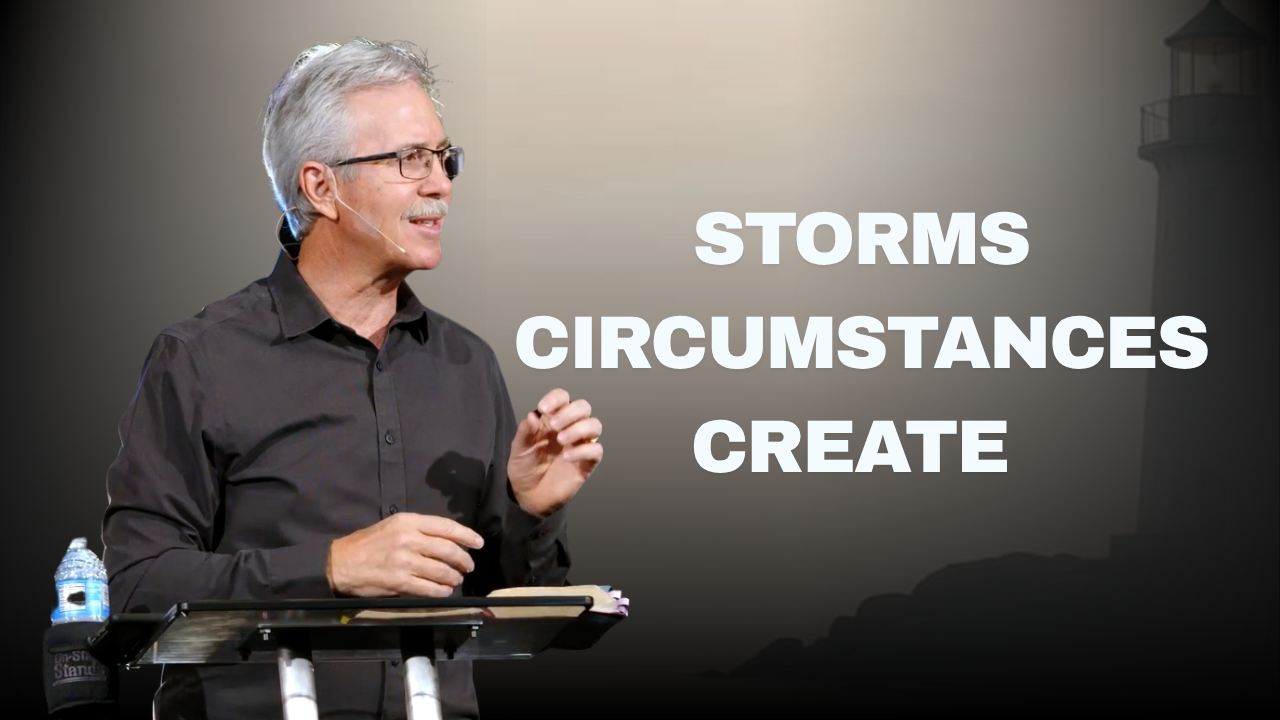
The second is the storm circumstances create.
The third is the storm God allows, and at times even arranges, for His greater purpose.
This article focuses on the second kind of storm: Storms Circumstances Create.
Here is the central thought: when circumstances, systems, leaders, or poor choices create storms around us, we overcome by refusing bitterness, seeking God for strategy, and allowing Him to steer the ship toward kingdom purpose.
We must not let circumstances define our inner reality. We must not allow the storm to bring us into confusion and chaos. We must maintain an eternal perspective with our eyes on Christ.
One thing that trips us up in a storm is losing our sense of peace when we are no longer anchored in God’s eternal perspective. We forget that Christ’s kingdom has no end. We forget that the peace of God has no end. Troubles come and go. Situations arise and eventually pass. But how we stay anchored in our relationship with the Lord determines how we navigate the journey.
It is not only about arriving at the destination. It is also about the journey.
I want peace and confidence throughout this journey. It is not enough to know that on the other side of this earthly realm, I will have eternal rest. I want to know that in this journey now, I have His victory, His confidence, His peace, and the assurance that I am an overcomer because He is an overcomer.
Discern the Storm
Not every storm is the same, and not every storm is navigated the same way.
There are storms the enemy sends. These are attacks designed to stop, overthrow, and derail us from God’s purpose. There are storms that circumstances create. These may stem from other people’s choices, our own choices, flawed systems, or unrelated causes. Then there are storms God allows—tests, refining processes, and moments of preparation intended for a greater purpose.
Eventually, all of us experience storms in life. Knowing which storm we are in and how to navigate it is essential to our well-being and our assignment. Learning to dis
Keep in mind that there are two spiritual kingdoms at work around us. There is God’s kingdom, full of light and love, revealed through Jesus. There is also Satan’s kingdom of death and destruction. But Jesus has defeated the powers of darkness through His death and resurrection.
The child of God is joined in spiritual union with Jesus and His victory. We live from Christ’s victory, from heaven toward earth.
His righteousness has become ours. His peace has become ours. His victory is ours. Christ has ascended on high, and we are seated with Him in the heavenly realm. We are secure in Him, loved in Him, and adopted through Him.
This is important because none of us are perfect. You are going to have a bad day. You may even have a bad hair day or two in your life! And when you do not feel especially spiritual or close to God, remember that through faith in Christ, you are closer to Him than you realize. You are in Him.
That matters when the storms are howling.
Here is an important question: Am I interpreting my current storm from earth toward heaven, or from Christ’s victory toward earth?
Are we looking at things only from the earthly realm, hoping heaven hears? Or are we confident that we are in Christ, seated with Him, and that He hears our prayers, watches over us, and is ready to answer?
A Brief Review: Storms the Enemy Sends
In the first message, we looked at Mark 4:35-41, where Jesus and the disciples encountered a storm while crossing the Sea of Galilee. Jesus had already given them the directive: “Let us go over to the other side.” There were people on the other side He wanted to reach. Ministry awaited. Purpose lay ahead.
But as they crossed the sea, a great windstorm arose. Jesus was asleep in the stern of the boat. The disciples panicked. They woke Him and said:
“Teacher, do You not care that we are perishing?”
—Mark 4:38 NKJV
Jesus rose, rebuked the storm, and said, “Peace, be still.” The word “rebuke” is significant because it is also used in Scripture when Jesus rebuked demons. This suggests that the storm may have been sent by the enemy to prevent them from reaching the other side.
Jesus rested while the disciples panicked.
Thoughts become things when they are fueled by fear. The storm was real, but fear magnified it until the disciples were convinced they were going under. Have you ever had a moment when panic gripped you? I have experienced such moments, especially in finance, when fear tried to seize me. Fear can feel very real.
But Jesus’ inner reality was anchored in the Father’s love and in who He was. His kingdom of peace was greater than the storm around Him. I believe what the earth needs in this hour is for the body of Christ across the globe to become conduits of the peace of God amid chaos.
Jesus challenged the disciples: “Where is your faith?” Their focus was on the storm, not on the greatness of God.
When the enemy sends a storm, we must rest in Christ’s victory, stand on God’s Word, pray with authority, and speak peace into the storm.
But this review matters because not every storm is handled the same way. When the enemy sends a storm, the emphasis is on spiritual authority. But in the storms circumstances create, the emphasis is on wisdom, prayer, endurance, discernment, and divine strategy amid situations beyond our control.
You cannot simply rebuke every circumstance. Sometimes you have to seek God for a strategy.
Storms Circumstances Create
Storms circumstances create may come through choices others have made or choices we have made. Have you ever made a bad choice and created a mess? Welcome to the human race. If we are honest, we all have.
Sometimes our choices create circumstances, and God’s grace and mercy help us walk through them. But there may still be consequences to navigate.
Other times, storms come through unrelated causes. Stuff happens in this life beyond our control.
Every system designed by humans is flawed to some degree. Engineers design machines, but machines wear out and sometimes malfunction. Inferior parts are sometimes used. Perhaps the engineers warned against using a certain fuel pump, but someone higher in management decided to save money and use it anyway. Then, three or four years later, tragic accidents occur because of a faulty part.
What if you were driving that vehicle? What if someone you loved was in it?
Governments are created, but they have inherent flaws and flawed leaders. America is a great nation, but it is not perfect. Our political system is not perfect either. Even good systems can fail us. Decisions made by those in authority can affect many others.
You may work for a company where the CEO makes a poor investment or a bad strategic decision, and suddenly the company is in trouble. I used to love Toshiba laptop computers, but decisions were made within that company that eventually contributed to Toshiba laptops disappearing from the market.
You may not have done anything wrong, but you were still in the crossfire.
So we must ask: What part of my current storm was created by circumstances I did not choose?
And then we must ask an even more important question: Has this made me angry or resentful? Can I forgive, release, and trust God?
Many people become angry with the government, leaders, employers, family members, or systems. But no political party, organization, or leader is perfect. People make bad decisions, and sometimes those decisions affect us.
But we must maintain an eternal perspective. Our eyes are on God’s kingdom, which has no end. He is the only One with a perfect government and a perfect system. Everything else is subject to chaos at times.
I learned this at a young age in the Navy.
I was enlisted in the Navy, serving on an aircraft carrier off the coast of Iran during the Iranian hostage crisis. Aircraft were loaded with bombs and rockets. President Carter was in office. We did not know if we were going to be told to drop bombs that day or not. It was tense.
In the middle of all that, our chief decided we needed to retile the shop floor. We were working around the clock on an aircraft carrier. There were no swimming pools, no luxury cruises, and no all-you-can-eat buffets. There were a lot of red beans and rice! Long stretches at sea are hard, so keep our service men and women in prayer.
But this decision to retile the floor seemed foolish. The other sailors—the “sea lawyers,” as we called them—decided I was the most articulate, so they sent me to talk to the chief.
I went in and tried to reason with him about why we should not redo the tile at that moment. I can still see his face. He looked at me and said, “Son, I want you to understand something. You are a sailor first and an electronics technician second. Now you get out there, get those guys, and get that floor tiled.”
“Yes, Chief.”
So we tiled the floor.
Two weeks later, the lieutenant in charge of our division came down and was not happy. He wanted to know who had tiled the floor and why. I told him, “Lieutenant, it was the chief.” Then there was a lot of yelling behind the office door.
I knew it was a bad decision, but the chief had the stripes. Sometimes you may disagree with someone’s decision, but there is still a chain of command.
That is not always a popular subject, even in church culture. We are all brothers and sisters in Christ, yes. But God also establishes delegated authority. We have to learn how to function in family, school, work, the military, and even church life without becoming disruptive every time we disagree.
Sometimes people in authority make good choices. Sometimes they make poor choices. And sometimes we do not even understand whether a decision was good or bad until later.
Paul Was Trapped by the Decisions of Others
Acts 27 gives us a powerful picture of a storm circumstances created.
Paul had preached the gospel, and God had revealed that he would go before Caesar in Rome. Paul had allowed himself to be taken as a prisoner because, in a mysterious way, this was part of God’s plan. He was being transported across the Mediterranean, and we pick up the story in Acts 27:9-12:
“Now when much time had been spent, and sailing was now dangerous because the Fast was already over, Paul advised them, saying, ‘Men, I perceive that this voyage will end with disaster and much loss, not only of the cargo and ship, but also our lives.’ Nevertheless the centurion was more persuaded by the helmsman and the owner of the ship than by the things spoken by Paul. And because the harbor was not suitable to winter in, the majority advised to set sail from there also, if by any means they could reach Phoenix, a harbor of Crete opening toward the southwest and northwest, and winter there.”
—Acts 27:9-12 NKJV
Sailing was dangerous at that time of year. Paul perceived danger and warned them, but he was not in control of the decision. He was a prisoner. The centurion listened to the helmsman and the ship’s owner rather than to Paul.
There were likely several factors at work. The ship’s owner may have wanted to deliver the cargo to Rome and be paid. The Roman centurion was probably following orders and wanted to deliver Paul and the other prisoners. Everyone had motives, pressures, deadlines, and responsibilities.
Does that sound like our world today?
Acts 27 continues:
“When the south wind blew softly, supposing that they had obtained their desire, putting out to sea, they sailed close by Crete. But not long after, a tempestuous head wind arose, called Euroclydon.”
—Acts 27:13-14 NKJV
At first, the wind blew softly. It looked like their decision was working. But not long after, a violent storm hit.
I have been on the Mediterranean Sea on an aircraft carrier when the seas were rough. When something as large as an aircraft carrier begins moving because of the waves, you realize how powerful these storms can be. I have seen waves crash over the bow of our carrier. Storms at sea can be terrifying.
Now imagine being on a wooden ship in the first century. These men feared for their lives.
Acts 27:18-20 says:
“And because we were exceedingly tempest-tossed, the next day they lightened the ship. On the third day we threw the ship’s tackle overboard with our own hands. Now when neither sun nor stars appeared for many days, and no small tempest beat on us, all hope that we would be saved was finally given up.”
—Acts 27:18-20 NKJV
All hope was finally given up.
That is what can happen in a storm. The whole situation could have been avoided if they had listened to Paul, but they did not. Now, everyone was suffering because of decisions Paul had not made.
Paul was affected by government authority and flawed leadership. He perceived loss, but his warning was dismissed. Many believers experience similar storms in business, government, family, ministry, or decisions made by those in authority.
Many Christians feel trapped by leaders’ choices. We may recognize that certain decisions will lead to loss, economic hardship, relational pain, or even shipwreck. But we must not let their actions trap our spirits.
We can live free in Christ, who is greater than every earthly power and every storm.
Ask yourself: Have I allowed the poor choices of others to imprison my attitude, peace, or faith?
Paul Refused Bitterness and Went to God
Paul did not become angry, resentful, and bitter. He did not merely complain about the bad decision or the corruption of the Roman system. He went to the Lord.
He prayed. He fasted. He waited on God for strength and strategy.
Acts 27:21-26 says:
“But after long abstinence from food, then Paul stood in the midst of them and said, ‘Men, you should have listened to me, and not have sailed from Crete and incurred this disaster and loss. And now I urge you to take heart, for there will be no loss of life among you, but only of the ship. For there stood by me this night an angel of the God to whom I belong and whom I serve, saying, “Do not be afraid, Paul; you must be brought before Caesar; and indeed God has granted you all those who sail with you.” Therefore take heart, men, for I believe God that it will be just as it was told me. However, we must run aground on a certain island.’”
—Acts 27:21-26 NKJV
Paul says, “Men, you should have listened to me.” I do not necessarily recommend saying that to your boss or leader! But Paul had received a word from God.
The ship would be lost, but every life would be spared.
God sent an angel with a message and a strategy. Everyone who stayed with Paul on that ship would live. Later, some sailors tried to escape by lowering the skiff into the water, but Paul warned the centurion that unless they stayed in the ship, they could not be saved. The centurion listened this time, and the soldiers cut away the ropes of the skiff.
Sometimes in a storm, people want to flee. But God may say, “Stay the course.”
Eventually, the ship ran aground near Malta. The vessel broke apart, but everyone made it safely to shore, just as God said. Then God used Paul mightily on the island of Malta. A great ministry opportunity opened. The gospel was proclaimed. Healing took place. The whole island was impacted.
Malta was not on the radar. Malta was not in the original plan.
Yet God used people’s bad decisions to add new territory for kingdom purposes.
Romans 8:28 reminds us:
“And we know that all things work together for good to those who love God, to those who are called according to His purpose.”
—Romans 8:28 NKJV
God works all things together for good. That does not mean every decision was good. It does not mean every circumstance was God’s will. It means God is so sovereign, wise, and redemptive that He can work even others’ bad decisions into His greater purpose.
The storm rerouted Paul, but the rerouting became an expansion.
You may be wondering, “I just got laid off. How can this be kingdom expansion?” You may not see it yet. Set your face toward God. Wait on Him. Ask Him for a strategy. Ask Him what He is saying in this moment. We do not know the truth of a situation until we have heard from Jesus.
Sometimes a closed door is an opportunity to walk through another door. Sometimes what feels like a delay is actually a divine rerouting.
Those Who Wait on the Lord
Paul’s response to the storm was not complaint, bitterness, or passivity. He waited on the Lord.
Isaiah 40:31 says:
“But those who wait on the LORD
Shall renew their strength;
They shall mount up with wings like eagles,
They shall run and not be weary,
They shall walk and not faint.”
—Isaiah 40:31 NKJV
The Hebrew word translated “wait” is qavah. It carries the idea of twisting or binding together. In this context, it means to be entwined with the Lord, wrapped around Him, waiting in expectation and trust.
Those who qavah themselves around the Lord will renew their strength.
If you have ever seen a rubber tree, you know how roots and trunks can grow together, twist around one another, and become intertwined. That is the picture. In the storm, we must wrap ourselves around the Lord.
Complaining has been called the language of hell. Murmuring, complaining, and gossip give the enemy a foothold. But prayer is the language of faith.
In the storm circumstances created, ask yourself: Am I spending more energy complaining about the decision or seeking God for a strategy?
Building During the 2008 Financial Crisis
Many of you have heard me tell the story of building our sanctuary.
In 2008, the nation and much of the world experienced what became known as the Great Financial Crisis. Housing and stock markets collapsed. Fear and financial panic spread. People lost homes and jobs. We had people in the congregation who were contractors and lost their entire businesses. Loans became difficult to secure. Church finances declined. Many families were under pressure.
Yet during that time, God challenged us to begin construction on a larger sanctuary.
It seemed like the worst possible time to undertake such a project. But there is our timing, and then there is God’s timing.
Jesus kept speaking to me: “Bob, I want My building built.”
I gave God every reason in the book why it was not a good time to build. Yet He kept speaking. There was so much work, pain, heartache, prayer, fasting, and labor with God through that process. It was not easy. There were many nights I did not sleep. It was hard.
But God said, “I want My building built.”
By December 2011, the building was finished. But before we reached that point, the contractor called and said, “I am going bankrupt. I cannot finish the church building.”
The building was about 75 percent done. Fear gripped me. I said, “God, You told me to build this building. We do not have enough money to finish it now.”
We prayed. We interviewed other contractors. The next contractor told us we would need another $300,000 on top of the $1.1 million we had already raised. In today’s dollars, this building would cost far more—probably over $3 million.
Somehow, through prayer, sacrifice, short-term loans, and faith, we came up with what was needed and finished the building.
But here is the amazing part. When the new contractor came in, he told us the previous contractor had put extra money into the foundation and walls. The foundation was thicker and more robust than the architect’s specifications required. The rebar was larger than required. The building was extremely well-built.
Here we are 15 years later, and there is not a crack in the foundation or walls.
What looked like a horrible situation became something God used. The contractor’s bankruptcy was painful, but God worked through another contractor to finish the project. What looked like a shipwreck became part of the provision.
God knows the end from the beginning. He is Jehovah Jireh, the Lord who provides, even in dire economic times. God often leads us into situations not of our choosing, and His leading may defy natural understanding. God is always good, but He is not always predictable.
Trust Him more than your natural understanding.
Ask yourself in your storm, “Could the delay or rerouting you resent become new territory for God’s purpose?”
God Overrules Poor Decisions
God can overrule poor decisions to fulfill His purposes and get you where you need to be.
This does not mean He endorses poor decisions. It does not mean that sin, foolishness, or failure do not matter. David’s sin with Bathsheba created a storm that affected many people, and God did not ignore its seriousness. But God’s redemptive power is greater than human failure.
Out of David and Bathsheba’s story came Solomon, who became known for wisdom. Again, God did not endorse David’s sin, but He proved that His mercy can bring wisdom out of failure.
God does not endorse poor decisions, but He is greater than them.
Leaders’ poor decisions and behaviors do not cancel the Lordship of Jesus.
Where do you need to trust that God’s redemption is greater than someone’s failure—including your own?
God wants to turn storms in nations, families, churches, and communities into opportunities for the Kingdom of God to grow and advance. This is an opportunity to pray and seek God’s face for strategy and revival.
History reminds us that God often moves in difficult times. In seasons of upheaval and uncertainty, believers have cried out for awakening. Let the memory of revival fuel present faith: “Do it again, God.”
The circumstances of the storm can become the setting where God reveals His glory and awakens hearts.
How to Navigate Storms Circumstances Create
1. Do Not Let Their Choices Trap Your Spirit
You may be affected by someone else’s decisions, but you do not have to be enslaved by bitterness.
Paul was physically trapped on the ship, but spiritually he remained free. He became the one with peace, wisdom, and direction when everyone else had lost hope.
Refuse resentment and bitterness. Refuse helplessness. Refuse the identity of a victim. Live free in Christ even when circumstances are constrained.
This does not mean we minimize trauma, abuse, or real suffering. But we must also recognize that the enemy wants people to take on a victim identity. Circumstances may be hard, but they do not have final authority over your outcome.
When the contractor called and said he was going bankrupt, I was angry. I was hurt. I was afraid. I wondered, “What if we do not get this done, God?”
But I had a choice. I could succumb to fear and failure, or I could set my face toward heaven and say, “God, You told us to do this. You said You wanted Your building built. Help us. Show us the strategy.”
And He did.
Do not let their choices trap your spirit. Live free in Christ.
2. Pray Until Heaven Gives Strategy
Paul prayed until angelic help arrived and divine strategy was released.
Storms and circumstances require more than reaction. They require discernment. You need to know what kind of storm you are in, and then you need heaven’s game plan.
Ask God for the word, the timing, the tone, and the course of action that will preserve life and advance His purpose.
Jeremiah 33:3 says:
“Call to Me, and I will answer you, and show you great and mighty things, which you do not know.”
—Jeremiah 33:3 NKJV
Jeremiah was in prison when God gave him that word. Judah was being taken captive to Babylon. Yet God said, “Call to Me.” Pray to Me. I will answer you. I will show you great and mighty things you do not know.
The Amplified Bible brings out the idea of God revealing what is fenced in and hidden. There are hidden things God wants to reveal. But we must seek His face.
What specific strategy do you need from God in this storm?
3. Let God Take Over the Ship
The storm circumstances create becomes a storm God steers once you let Him take over the ship.
Your life is like a ship on a course. God has a path and a journey for you. You can fight against certain things all you want, but some walls are not going to move. You can punch the wall in your home all day, but it won’t move.
Some circumstances will not change simply because you are angry at them. You can be angry at the government, the economy, gas prices, your employer, your family, or your situation, but anger alone will not move the ship forward.
Seek the face of God. Worship Him. Ask Him for perspective. Ask Him for a strategy. Surrender control and trust Him.
Proverbs 3:5-6 says:
“Trust in the LORD with all your heart
and lean not on your own understanding;
in all your ways submit to him,
and he will make your paths straight.”
—Proverbs 3:5-6 NIV
What would it look like practically for you to let God take over the ship?
I had to learn this as a young man. When my dad walked out on my mom, I was the oldest of five children. Some older men came up to me and said, “Now you have to be the man of the family.”
That is not something a young teenage boy is equipped to carry. In fact, that is often the worst thing you can say to a young person going through a family divorce. What they need to hear is, “Son, we are here. We want to help you. We want to help your mom. We want to help your family.”
In America, many children are raised by single parents, most often by moms. These moms can feel like widows, and these children can feel like orphans in certain ways. We need to have a heart for them.
I had to learn early to trust God. I would not want that situation on anybody, but looking back, it made me gritty. Some of us need a little grit. Life is hard. We cannot live with an entitlement mentality or a victim mentality. We must seek God’s face and trust that He has a plan.
I was talking to a young man recently who shared how much his dad had helped him—teaching him how to fix things and do practical work. I was happy for him. But I also thought, “I never had that.”
The Navy helped me grow up. Life helped me grow up. God helped me grow up.
Somehow, through everything the enemy throws at us and through the storms circumstances create, if we seek God and stay on course, it is amazing what He will do.
Closing Exhortation
You may not have chosen the storm.
You may have warned others and been ignored.
You may be living with the consequences of decisions you did not make.
But God is not limited by those circumstances. Even if you made the worst decision ever, God is still there. David said, “If I make my bed in hell, behold, You are there.” God does not abandon us when we make poor choices. And He is not limited by the poor choices of others.
He knows how to preserve life, expand territory, draw wisdom from failure, and get you to Rome by way of Malta.
What seems like a shipwreck may become the very thing that gets you to your destination.
So do not complain—pray.
Do not become bitter—seek strategy.
Do not assume rerouting means defeat—it may mean kingdom expansion.
Let God steer the ship.
If you are in a storm right now, take a moment before the Lord. Repent of any wrong attitude, bitterness, resentment, or unforgiveness. Ask the Lord to forgive you for holding on to what He is asking you to release.
Then surrender the ship.
Say, “Lord, I surrender. Guide the ship. Give me Your perspective. Show me what this storm is, where I am, and how I should move forward.”
Ask Him for strategy.
Father, I pray for Your people. Bring Your peace. Silence the storm within. Give divine perspective and heavenly strategy. Teach us to trust You in the storms circumstances create. You are greater than every storm and every circumstance. In Jesus’ name, amen.