Jesus Christ is the same yesterday, today, and forever (Hebrews 13:8). He was the Healer then, and He is the Healer now. He was the Savior then, and He is still the Savior today.
That conviction is where we begin when we pray for healing. We come to a loving Father whose heart has been revealed through His Son. God loved the world so much that He gave His only begotten Son so that whoever believes in Him would not perish but have everlasting life (John 3:16). Jesus said, “He who has seen Me has seen the Father” (John 14:9). His compassion, His mercy, and His works of healing show us what the Father is like.
Acts 10:38 describes Jesus going about doing good and healing those oppressed by the devil because God was with Him. Every healing revealed something of the Father’s loving nature. God is not the author of confusion (1 Corinthians 14:33), and when we look at Jesus, we see Him confront sickness, restore broken lives, and bring freedom.
As we continue learning to partner with Jesus, we need more than information about healing. We need to recognize His presence, listen to His Spirit, and respond to what He is doing. Sometimes that means setting aside our preferred order of service or teaching format to follow His direction.
My prayer is that the Lord would quiet the voices of doubt and release faith in our hearts—not only for a particular service but for the whole journey of walking with Him.
Healing was Central to Jesus’ Ministry
In many places where the Gospels summarize His work, they explicitly mention healing.
“Now Jesus went about all Galilee, teaching in their synagogues, preaching the gospel of the kingdom, and healing all kinds of sickness and all kinds of disease among the people.” Matthew 4:23 NKJV
Notice those words: all kinds.
No category of illness was beyond His authority. Whether we consider leprosy in the biblical accounts or devastating diseases such as AIDS and Ebola in our world, nothing is too hard for Him.
Over the years, I have seen remarkable things happen when people prayed. Sometimes I prayed; sometimes someone else did. The important thing was never who received the attention. Jesus was the One who healed.
God may grant specific gifts of healing to certain people, but praying for the sick is not reserved for a few well-known ministers. Paul speaks of “Christ in you, the hope of glory” (Colossians 1:27). Mark 16:17–18 also speaks of believers laying hands on the sick and seeing them recover.
If you belong to Jesus, His Spirit lives in you. You do not need to become a celebrity, earn a title, or complete years of training before you can ask Him to touch someone.
Sometimes the simplest examples come from children.
Carolyn told me about an incident involving our grandsons the day before this message. Our younger grandson, about a year and a half old, had been hurt. His four-year-old brother said, “Let me pray.” When he finished praying, the younger one stopped crying and seemed better.
I also knew a sword-related mishap had happened during their play that day! With little boys, there is often plenty of action. But what stayed with me was that simple response: Let me pray.
I have seen school-age children pray for people, and remarkable things have happened. They may not know much about ministry, but they know enough to ask Jesus.
One experience in India brought this home to me in an unforgettable way.
A college-age young man named Tim was with our team. His father was a Baptist pastor in Virginia, and Tim came from a church background that did not expect God to work through miraculous healing today. Through Global Awakening, he had begun hearing testimonies about healing and learning that the kingdom of God is both present now and yet to come in its fullness.
We were ministering in a largely unreached area with many Muslims. During the day, we went through a village, inviting people to the evening meetings and praying for those who wanted ministry.
Meanwhile, I had developed a miserable head cold.
Here I was, supposed to lead the team and preach about healing, yet I could not shake my own cold. I prayed and prayed, but it wouldn’t go away. Eventually, feeling thoroughly worn out, I sat in a chair and watched the others minister. So much for the great man of faith!
An older blind man came to Tim for prayer. As Tim prayed, I saw the man’s eye change. His eye opened, and he could see.
That caused quite a stir. Then another older blind man came forward. Tim prayed, and that man’s eye opened too.
I sat there thinking, “God, You are God, and we are not. I want this head cold to go, but You are obviously doing something with blind eyes right now!”
Then a third blind man came, and he was healed too!
I had never seen anything quite like it. I don’t know whether I will ever see anything like it again. But I saw it, and I knew God was at work.
The young man who had never seen a major miracle was praying, and people were receiving their sight. The team leader was sitting in a chair with a head cold. Experiences like that remind us who the Healer really is.
Jesus also made Healing Central to the Assignment He gave His Disciples
Matthew 10:1–8 records this commission:
“And when He had called His twelve disciples to Him, He gave them power over unclean spirits, to cast them out, and to heal all kinds of sickness and all kinds of disease.” NKJV
He then sent them out, saying:
“And as you go, preach, saying, ‘The kingdom of heaven is at hand.’ Heal the sick, cleanse the lepers, raise the dead, cast out demons. Freely you have received, freely give.” NKJV
The authority He gave them reflected the ministry He Himself was carrying out.
Look at the people He called: Peter and Andrew; James and John; Philip and Bartholomew; Thomas and Matthew; James the son of Alphaeus; Lebbaeus, whose surname was Thaddaeus; Simon the Cananite; and even Judas Iscariot, who would betray Him.
James and John were the “sons of thunder,” and at one point wanted to call fire down on people (Mark 3:17; Luke 9:54). Yet Jesus called them and worked through them. These were imperfect people learning to follow a perfect Savior.
On that particular mission, Jesus directed them to the lost sheep of Israel rather than to the Gentiles or Samaritan towns. Later, the commission would extend to all nations.
When I first encountered these passages as a young believer, some parts were easier to receive than others. Praying for the sick seemed understandable. Believing Jesus could deliver someone from demonic oppression was another step, but I had seen that happen.
Then there was the command to raise the dead. I struggled with that for years.
I remember meeting a humble pastor in Mozambique who invited two other pastors and me into his church. It had a thatched roof, a dirt floor, and a simple pulpit that did not look especially sturdy.
He pointed to a place near the pulpit and said, “This is where the first one was raised from the dead.” “The first one?” I thought. “There was more than one?”
He told us that three people had been raised from the dead in his congregation. In some places, the circumstances surrounding death differ greatly from what we are accustomed to. A considerable interval may pass before anyone comes to take the body, and believers may spend that time praying.
Another testimony I heard in Africa came from a pastor’s wife.
A grieving mother brought her baby to this woman one evening, saying that the baby had died. Heartbroken, she asked, “Mama, can you do something?”
As the pastor’s wife later told a group of us leaders, she had never been taught how to pray for the dead. She did not know what to do. She simply took the baby, sat in a chair, and held the little one through the night.
She worshiped. She praised Jesus. She kept holding that baby.
Nothing visible changed through the night. Then, she said, as the first light of morning began appearing over the horizon, the baby’s eyes opened! According to her testimony, the baby had come back to life.
Someone might question whether the child had actually died. I understood that possibility, but I believed these women’s account. The pastor’s wife was not presenting herself as someone with a special technique. She had held a grieving mother’s baby and worshiped Jesus.
And her story did not end there. Later, another baby in the village was brought to her after being reported dead. She said she did the same thing: held the child and worshiped through the night. That baby also came back to life.
I think of mothers and grandmothers who have prayed over children who are lost, broken, or far from God. In a different sense, you may feel as though you are holding that child before the Lord through a long night, praying, “God, if You can do anything, please move.”
We do not always know what to say. Sometimes all we know to do is keep loving, keep praying, and keep worshiping. Yet we must also be honest about what we do not understand.
One of our elders, Ed, has testified about being healed of cancer, and he gladly tells people about it. I have also known people who were not healed of cancer, including my own mother.
I cannot explain every outcome. There is mystery here.
I remember another occasion in our old sanctuary, before we built the present one. Someone on our ministry team received what we understood to be a word of knowledge: a picture of a heart with a hole in it.
When we shared that impression, someone said it meant something to them. A relative in Phoenix was scheduled for surgery because of a hole in his heart. We prayed. There was no fanfare, no fireworks, and nothing dramatic to observe.
A few days later, we received the report that when the surgeon operated, the hole was gone! According to the account relayed to us, the doctor had the earlier image showing the problem, but could not find the hole during surgery.
There are things we cannot explain. We receive such testimonies with gratitude, while remembering that God remains God even when another prayer seems unanswered.
The Great Commission
Following His resurrection, Jesus gave the Great Commission recorded in Matthew 28:18–20.
And Jesus came and spoke to them, saying, “All authority has been given to Me in heaven and on earth. Go therefore and make disciples of all the nations, baptizing them in the name of the Father and of the Son and of the Holy Spirit, teaching them to observe all things that I have commanded you; and lo, I am with you always, even to the end of the age.” Amen. NKJV
Paul tells us that the risen Lord appeared to more than five hundred believers at one time (1 Corinthians 15:6). The crucified and risen Christ declared that all authority in heaven and on earth belonged to Him.
He commanded His followers to make disciples of all nations, baptize them in the name of the Father, Son, and Holy Spirit, and teach them to observe everything He had commanded. He also promised to be with them to the end of the age.
I believe the earlier commissioning passages—Matthew 10, Mark 6:7–13, and Luke 9:1–6—help us understand what that ongoing discipleship includes. Jesus had taught His disciples to proclaim the kingdom and minister to the sick. The Great Commission calls them to pass on what He taught them in those earlier commissioning accounts. I discuss this in length in my book Receive Your Miracle Now! A Case for Healing Today
We readily affirm preaching the gospel, making disciples, caring for the poor, helping widows, and serving people in need. I believe we should also continue praying for the sick.
Some Christians understand the miraculous gifts as belonging primarily to the church’s foundational period (AD 30-400). I believe those gifts have continued and that God still works miracles today.
Our faith is already rooted in God’s supernatural work. He forgives sin, gives new life, places His Spirit within us, and promises resurrection. When I look in the mirror, I still see an imperfect person. Yet Jesus has redeemed me and is preparing a place for me (John 14:2–3). That is a miracle.
As passionately as we pursue physical healing, our hope reaches beyond this present life. Sometimes the ultimate healing comes when we pass into Christ’s presence, and we await the fullness of resurrection life.
The God who spoke the universe into existence also knows the number of hairs on our heads (Matthew 10:30). He knows when we sit down and rise up, and understands our thoughts before we express them (Psalm 139:1–4). This is the God with whom we are learning to partner.
Different Ways Jesus Ministered to the Sick
Jesus ministered with unparalleled power and authority, but He did not use the same method every time. His ministry flowed from His relationship with the Father. In John 5:19–21, He explained that He did what He saw the Father doing.
Every act of mercy revealed the Father’s heart.
Jesus was moved by compassion. Matthew 8:16 describes Him healing all who were sick that evening. His ministry reached people suffering physically, emotionally, and spiritually. Mental illness, emotional turmoil, demonic oppression, and even death were not beyond His authority.
Where faith was present, people eagerly received His ministry. Unbelief also mattered. Mark 6:5 describes the limited miracles in His hometown, where people could not see beyond their familiarity with Him. Luke 4:23–28 likewise reveals resistance to Him and His message.
Unforgiveness and bitterness are also matters we should bring before the Lord. But we must never assume that someone who remains sick harbors unforgiveness or lacks faith. We simply do not know enough to make that judgment.
The grace of Jesus reaches into the deepest human brokenness. His blood is sufficient for the most broken person and the person whose life has wandered furthest from Him. He addresses our sin and cares about the wounds we carry.
The Gospels also emphasized the power present for healing. Luke 5:17 says, “The power of the Lord was present to heal them.” I have been in meetings where healing seemed unusually easy, where there was a strong awareness of God’s presence, and people responded readily. We cannot manufacture those moments, but we can recognize them and respond.
The variety in Jesus’ ministry teaches us to remain attentive.
Sometimes He touched people. Matthew 8:15 tells us that He touched Peter’s mother-in-law’s hand, and her fever left. She got up and began serving them.
Anyone who has cared for a feverish child or a sick loved one can appreciate that scene. How wonderful it would be to see a simple touch accompanied by immediate relief.
At other times, someone touched Him. The woman in Luke 8:44 reached for the border of His garment and was immediately healed of her bleeding.
Jesus also prayed. John 11:4 introduces Lazarus’s illness as an occasion for God to be glorified. Later, at the tomb, Jesus addressed the Father and then called Lazarus out. The fuller account of His prayer and Lazarus’s resurrection appears in John 11:41–44. Jesus’ prayer at the tomb
Sometimes He ministered through a command or declaration. In Matthew 8:8, the centurion expressed confidence that Jesus only needed to speak for his servant to be healed. Luke 7:9–10 records Jesus’ response to that faith and the servant’s recovery.
Sometimes He combined touch with a spoken command. In Luke 5:13, He touched a man with leprosy and declared His willingness to make him clean.
Other accounts seem unusual to us. Mark 7:33 describes Jesus putting His fingers in a deaf man’s ears and touching the man’s tongue with saliva. This was the healing of a deaf man who had difficulty speaking. A separate account, Mark 8:22–25, describes a blind man receiving sight in stages.
In John 9:6–7, Jesus made mud, applied it to a blind man’s eyes, and told him to wash. With all the rain outside during our service, plenty of mud was available! But the point is to follow Jesus’ leading, not turn an unusual action into a required technique.
Sometimes He invited an act of faith. In Luke 6:10, He told a man to stretch out his hand. As the man responded, his hand was restored.
Sometimes, during prayer, someone can gently check whether movement has become easier or pain has changed. We should never pressure people to force movement or prove their faith. We are learning to notice what God is doing.
Jesus also asked questions. Spiritual insight did not eliminate personal interaction. We can listen to the Holy Spirit and ask the person what is happening, how long a condition has been present, or whether anything has changed.
On some occasions, Jesus also addressed the person’s spiritual life, warning, “Sin no more” (John 5:14). His concern extended beyond an isolated symptom to the whole person.
He also spoke of physicians as people needed by the sick (Mark 2:17). Luke himself was a physician (Colossians 4:14).
I want to be very clear: receiving medical care is not a lack of faith. We believe God works through doctors, and we are grateful for medicine. Prayer and appropriate medical care belong together.
I discuss healing more fully in my book, Receive Your Miracle Now: A Case for Healing Today. The appendix also addresses Jesus’ healing ministry and a five-step prayer model we use. Such models can help us learn, but no model can replace dependence on the Holy Spirit.
An experience in Brazil illustrated this beautifully.
Carolyn and I were there a few years ago when a woman came for prayer concerning a deformity in her left arm that had been present since birth. Through an interpreter, she explained what she wanted prayer for. We began praying for her arm, but I did not see any visible change.
Then God’s presence seemed to rest on her very strongly. I asked the young man beside us to move behind her because she looked like she was about to fall. He caught her and helped her lie down safely. That doesn’t happen every time we pray, but it did on this occasion.
After a few minutes, she got up smiling. Through the interpreter, I asked what was happening. She explained that she had also been deaf in one ear since birth, though she had not mentioned it. Now, she said, she could hear through that ear!
We had been concentrating on her arm. She was rejoicing over her hearing.
Jesus sometimes works in ways we do not anticipate.
No single prayer model applies to every situation. The Holy Spirit may direct us to pray about something the person has not mentioned. The setting may also affect how we minister. A large crusade, a church service, a conversation on the street, and a visit in someone’s home each provide different opportunities.
Healing may be instantaneous. It may unfold gradually as we pray. It may follow repeated times of ministry. Sometimes the healing we seek does not come.
God is the Healer. He acts in His wisdom, in ways and at times we do not control. Our responsibility is to pray faithfully and love the person before us. We can entrust the outcome to Him.
We may focus on a physical condition while the Lord draws attention to grief, a need to forgive, or an inner wound. That does not mean every illness has an emotional or spiritual cause. It means He knows the whole person.
I remember a service when a young couple I had never met came forward for prayer. As I approached them, I sensed the Lord saying that the woman was grieving the loss of a child. I hesitated. That is a deeply sensitive thing to bring up, and I did not want to be wrong. But the impression came three times. Finally, I asked whether she had recently lost a child.
She burst into tears, and her husband held her as she wept. They were visiting family in town, she explained, and the previous day had been the first anniversary of their child’s death. They had found our church online and felt the Lord directing them to come.
I did not know their story. God did. That simple question helped her recognize that the Lord saw her grief. Then we prayed.
Whether someone receives a specific word for you or not, God knows your situation. He knows the loss, the diagnosis, the procedure that did not bring the hoped-for relief, and the pain you have struggled to explain.
Ministry During the Healing Service
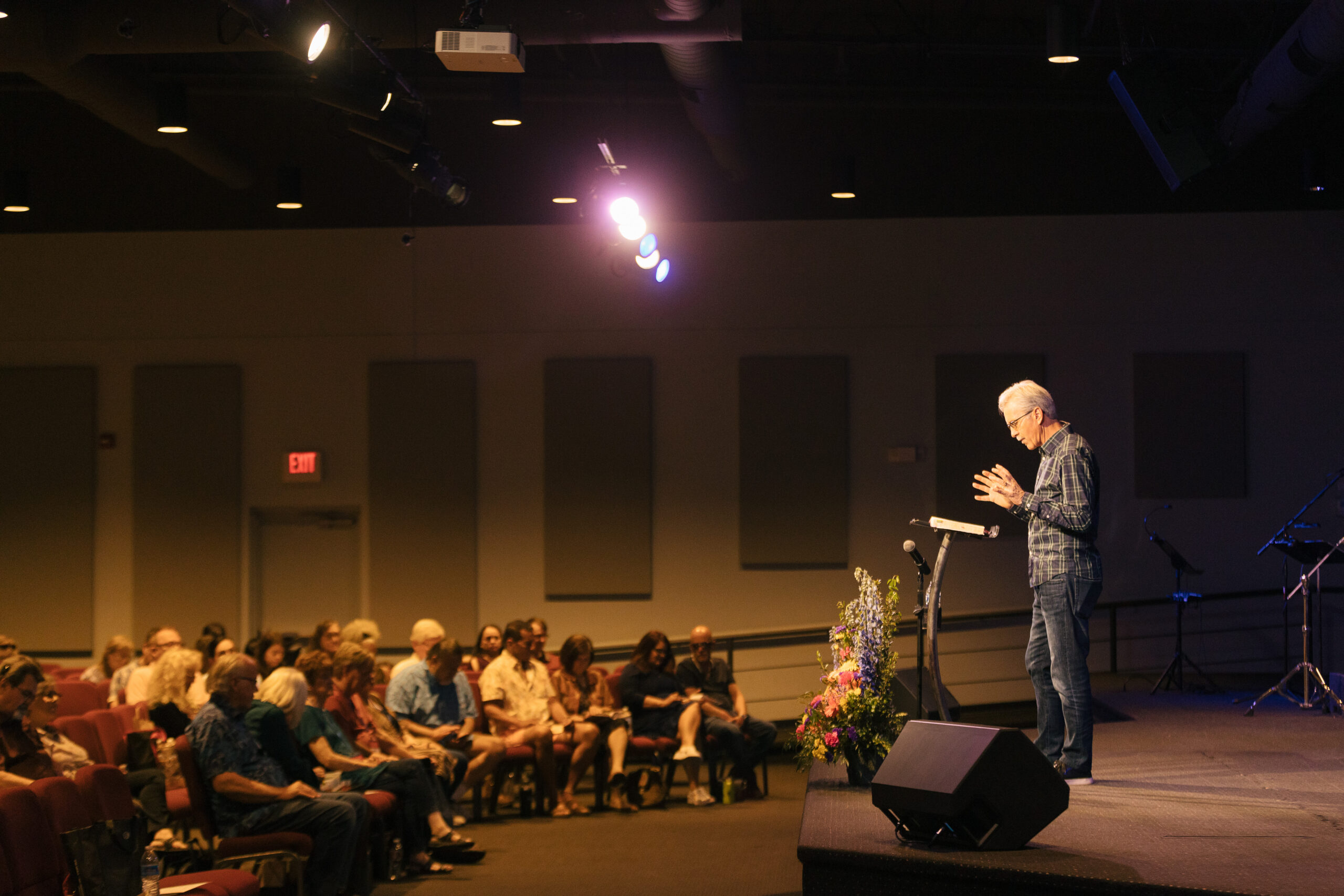
As this service moved into prayer, we sought to put these truths into practice.
I first sensed a prompting to pray for people with fibromyalgia and persistent bodily pain. We prayed for relief, restoration, and the Lord’s healing presence. We also prayed separately for people with autoimmune conditions, asking others to gather around them.
I encouraged those ministering to ask simple questions, listen, and pray briefly and directly. “Pain, go. Be healed in Jesus’ name.” Those prayers expressed dependence on Jesus’ authority.
I also prayed for my friend Doug, a retired pastor in Maryland who had recently been diagnosed with PMR. He was experiencing significant pain and difficulty in his joints and had been prescribed prednisone for an extended period.
We thanked God that doctors had identified the condition and provided treatment. Then we asked the Lord to bring healing beyond what the medication could accomplish.
When I asked about kidney problems, Ruth responded and explained that she had suffered a kidney injury. We prayed for the damage to be healed, for pain to leave, and for her kidney function to be restored.
We also prayed for people with back problems, including Jeff, a friend who had already undergone surgeries and was facing another procedure.
Jeff was one of my playing partners when I made two holes-in-one about a year and a half earlier. I joked that I had offered him money to attend so someone could verify the story! If you have seen my golf swing, you know those shots were miracles of their own!
But his back pain was serious. We asked God for more than temporary relief. We prayed that he would regain the ability to walk comfortably and return to activities he enjoyed—hunting, fishing, and playing golf.
I also sensed a prompting concerning the L4–L5 area of the back, and another man responded. We prayed for those with chronic back pain, sciatic pain, and related discomfort in their hips and legs.
As people continued praying, I encouraged them to check how the person was doing and remain attentive. Sometimes we do not see an immediate change. We can keep praying without becoming anxious or trying to force an outcome.
Exodus 15:26 reveals the Lord as our Healer: “I am the LORD who heals you.” We often speak of Him as Jehovah Rapha. We called upon Him to restore what was damaged and to bring healing where people were still suffering after surgery.
We also spoke the peace of Christ over those who were waiting. People need His comfort and sustaining grace as they believe for healing.
The atmosphere that day reminded me of the weather outside. Just as we were surrounded by the rain, we were conscious of being surrounded by God’s presence. I encouraged people to take their time—to remain in prayer and allow themselves to receive.
Then we gathered around Brenda.
Many in our congregation knew her and her husband, Pete. Pete had served on the worship team for years, and Brenda had faithfully led our food box ministry. She had recently received a diagnosis of stage-four cancer.
With her permission, people gathered around her in love. We prayed against the cancer and asked for healing in every affected part of her body, including her lungs, stomach, and kidneys. We asked that she would be able to eat again, regain strength, and get out of her wheelchair.
We prayed for masses to dissolve, for organs to be restored, and for every trace of disease to be removed.
These were our requests before the Lord. We were looking to Him for the outcome.
Psalm 107:20 tells us that He sent His word and healed His people. Hebrews 4:16 invites us to come boldly to the throne of grace for mercy and help in our time of need. That is what we were doing together.
We also brought before Him glaucoma, hearing loss, other physical needs, and the wounds of grief. We asked for restoration of bodies and hearts.
Philippians 4:6 calls us to bring our requests to God through prayer and supplication with thanksgiving. Even while we wait, we can thank Him that He hears us.
The Holy Spirit is our Helper, given to be with us forever (John 14:16–17). He is fully God, co-eternal with the Father and the Son. He comforts us, helps us, and makes the presence of Christ real in our lives.
We are not trying to conduct Jesus’ ministry without Jesus. Through His Spirit, He is present with us.
So what would you like the Lord to do for you today?
Bring that need honestly before Him. If you need to forgive someone, ask Him for the grace to release that person. If grief has wounded your heart, tell Him. If you are struggling to believe, you do not have to disguise that struggle.
You can pray the words of the father in Mark 9:24: “Lord, I believe; help my unbelief!”
We do not have all the answers. We have Jesus, and we can continue learning to trust Him.
Father, thank You that You know every person reading these words. You know every diagnosis, every disappointment, every unanswered question, and every hidden wound. Holy Spirit, come with Your healing presence. Restore bodies, comfort grieving hearts, strengthen the weary, and renew hope where it has been deferred. Teach us to listen, to love, and to partner with Jesus. Give us courage to pray and grace to entrust every outcome to You. In Jesus’ name, amen.