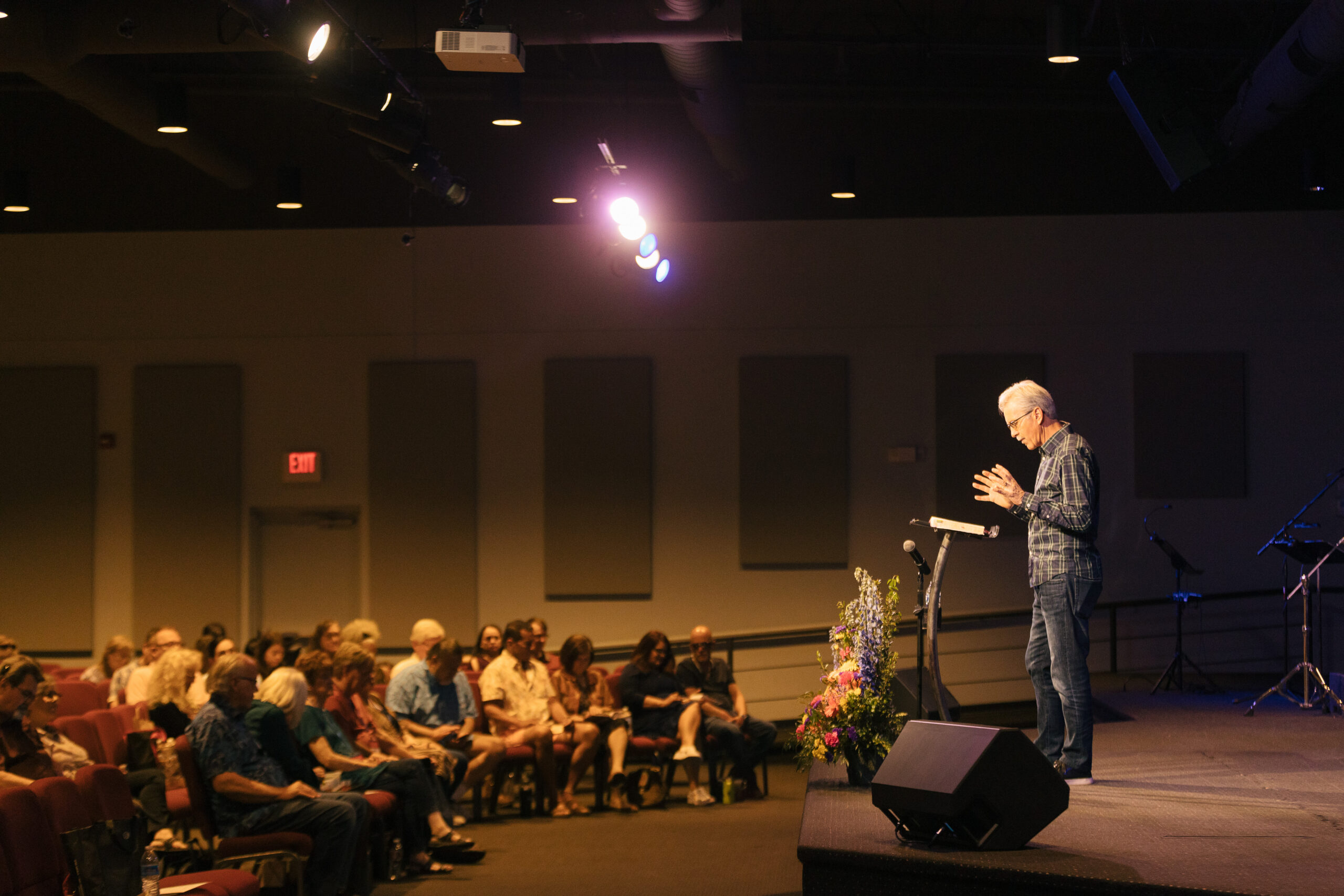
Last week, I asked everyone to spend at least thirty minutes quietly waiting on the Lord. Not thirty minutes a day, just thirty minutes during the week. Even if you sat there and did not think you heard anything, you still spent thirty minutes in the presence of Almighty God. Let that sink in. How much is it worth simply to be with the Creator?
One Essential Thing
We began this series with Mary and Martha in Luke 10:38-42. Martha was busy serving while Mary sat at Jesus’ feet and listened to His word. When Martha grew upset that Mary was not helping, Jesus replied, “One thing is needed, and Mary has chosen that good part” (Luke 10:42). The Message puts it this way: “One thing only is essential.” Mary quieted herself and chose to listen, not only to be taught but also to relate to Jesus.
Jesus was not saying that serving is wrong. Martha’s problem was that serving had taken precedence over waiting on the Lord, hearing His voice, and responding to His words. Many things can help us grow as Christians: Bible reading plans, study tools, commentaries, sermons, and good teaching. But Jesus identified the essential thing. We must stay close to Him and learn to recognize His voice.
If you believe that Jesus died and rose again and have given your life to Him, the Spirit of God lives in you. God is not far away. Paul described the mystery of the gospel as “Christ in you, the hope of glory” (Colossians 1:27). We are not trying to connect with a distant God. We live in fellowship with the God who is already present. Our part is to know Him and intentionally position ourselves before Him.
The parable of the sower teaches us to hear God’s Word, believe it, obey it, and act on it. Jesus also said, “With the same measure you use, it will be measured to you” (Mark 4:24). In the ancient marketplace, people brought a measure of grain, wheat, or flour. If you brought a pint, you received a pint. If you brought a quart, you received a quart. The measure you brought determined what you could receive.
What measure are we bringing before God? What capacity are we making available for what He wants to say? As we wait on the Lord, our capacity for faith grows. I called it a “faith bucket” in the sermon, and some of us need a few more acres in ours!
I grew up in the Midwest, where my grandfather had a two-hundred-acre dairy farm that my cousin now owns. We grew corn, soybeans, oats, and hay, raised dairy cattle, and did all the work that goes with them. Farm life taught me something simple: if you want a harvest, you must plant seed. If you plant no seed, don’t expect a harvest. Jesus said the seed is the Word of God. We put that seed into the good soil of our hearts so it can bear thirtyfold, sixtyfold, or a hundredfold fruit. Why stop short? Plow the soil of your heart and enlarge your capacity to receive.
Faith comes by hearing, and hearing by the word of God. Romans 10:17
The more we read the Word, the more our faith grows. The more we sit at Jesus’ feet and listen to what He says, the more our faith grows. As we do, we also learn to distinguish God’s voice from our own and from the enemy’s. The enemy can hide his voice behind the world’s values, fears, and pressures. That is why learning to recognize God’s authentic voice matters so much.
A Church That Prays and Listens
During worship, I thought about Ukraine and our dear brother Frank, who is there now. In 2003, I traveled to Ukraine and ministered in Kyiv alongside others. I had the privilege of speaking in one of the country’s largest churches, led by a Nigerian pastor whom God had called to Ukraine many years earlier. In fact, two of Ukraine’s largest churches were led by Nigerian brothers who heard God tell them to go there and plant churches. They obeyed, and the churches grew.
We also traveled east to Kharkiv, near Russia—a place that would become fiercely contested years later in the current war. The church there met in a nightclub, complete with a disco ball! When I first walked in, I wondered what kind of meeting we were about to attend. Yet three or four hundred people filled the room, and God’s presence was extraordinarily strong.
Before one of the services, our American team prayed with Ukrainian believers. People began to weep in God’s presence. I have attended prayer meetings in many places around the world, but I am not exaggerating when I say that after a while I got on my hands and knees and crawled out of that room. God’s presence was that weighty. In that atmosphere, the Lord also gave clear words about what He wanted to minister in the meeting.
That experience showed me the value of seeking God both individually and alongside other believers. It also raises an uncomfortable question: are we willing to pay the price to reach that place in prayer, or do we expect someone else to pay it for us? If we want God to move in our nation, we must set aside time in our schedules, gather with others, and pray.
The American church has often lost that burden. I have pastored here for twenty-five years, and more than once we have had to cancel a prayer meeting because no one showed up. I say that with love, not condemnation. But the younger generation must ask what it truly wants. Do we want only social events and a good lesson on Sunday, or do we want more of God? I am getting grayer and have only so much time left in the saddle. I do not even like riding horses—they hurt my backside—but you understand the picture!
I still wonder how the believers I met in Ukraine are doing. I served in the Navy and was stationed on aircraft carriers off Beirut and Iran. I have seen military operations, but I cannot imagine living on the receiving end of rockets, bombs, and drones. Church, it is a good time to pray.
My Sheep Hear My Voice
John 10 presents Jesus as the Good Shepherd, one of the great “I am” revelations in John’s Gospel. In John 10:22-30, Jesus was walking in Solomon’s Porch during the Feast of Dedication. He was in the Second Temple, built after the first was destroyed.
Haggai had prophesied, “The glory of this latter temple shall be greater than the former” (Haggai 2:9). At the dedication of the second temple, older people who remembered the grandeur of the first wept, while the younger generation rejoiced. Yet the latter house would receive greater glory because Jesus Christ, the Messiah and eternal Son of God, would one day walk there.
That gives me hope for the church today. Perhaps some of you remember reading about the First and Second Great Awakenings, the Latter Rain revival, the Charismatic Renewal, the Jesus People movement, the Toronto outpouring, or the Brownsville revival in Pensacola. They remember seasons when God’s presence was powerful, and many people came to Christ. The church today may not always seem as glorious as it did then, but could God be preparing the way for something beyond good programs?
I thank God for large churches where many people are coming to Christ and being baptized. One leader told me their church baptized 1,700 people last year, which is wonderful. At the same time, whether a church is small, mid-sized, or large, we must earnestly refuse to be content while our city remains largely unchanged. Years ago, pastors in our city talked about filling the football stadium with believers. We are still waiting. I enjoy a good football game—and I still think Indiana should have beaten Ohio State this week, though we’ll leave Notre Dame and BYU alone—but no game compares with the presence and power of God among His gathered people. That kind of gathering begins when people decide to pray.
When the religious leaders surrounded Jesus and demanded a clear answer about whether He was the Christ, He pointed to the works He did in His Father’s name. Yet they refused to believe. Jesus explained that their unbelief showed they were not His sheep. Amid that confrontation, He gave one of the clearest descriptions of His followers: “My sheep hear My voice…” (John 10:27).
We minister in a culture where many people are not listening for Him. Only five to seven percent of Tucson’s population attends church. That does not mean every unchurched person rejects Jesus. Some love Him but have been hurt or disappointed by the church; others have not worked through the obstacles that keep them from belonging to a congregation. Even so, the estimate shows how much of our city is not actively gathering to hear and follow Christ. It also challenges those of us who do gather to ask how seriously we want to bear fruit—and what time and resources we are willing to give to God’s purposes in our generation.
My sheep hear My voice, and I know them, and they follow Me. And I give them eternal life, and they shall never perish; neither shall anyone snatch them out of My hand. John 10:27-28
Jesus continued, “My Father, who has given them to Me, is greater than all; and no one is able to snatch them out of My Father’s hand. I and My Father are one” (John 10:29-30). His hearers understood that He was claiming equality with God. A few verses later, they said they wanted to stone Him because, “You, being a Man, make Yourself God” (John 10:33). They stood before God in human flesh and still could not recognize Him.
Jesus says His sheep hear His voice. He knows us, leads us, and keeps us secure. That assurance matters when He calls us to do something radical, costly, or even dangerous. We need to know we’ve heard our Shepherd.
Years ago, Pastor Carolyn led a group of young people on a ministry trip to Brazil. Local leaders took them into a favela—a desperately poor neighborhood where drug lords controlled the streets. Armed men blocked the way, and outsiders needed permission to enter. Carolyn may not seem like a formidable opponent to drug lords, and neither did the teenagers with her. But God is formidable. The group was allowed to enter, and they had a wonderful meeting. God wants to work in the hardest, darkest places, but we must know His voice well enough to follow Him there.
A shepherd doesn’t make it hard for sheep to follow; they learn his voice by staying close to him. Pigs are another matter—they run everywhere. Cats usually don’t follow commands either, but our cat, Lucy, is an exception. I never wanted a cat. Our daughter brought Lucy home while she was in college, then later got married and became pregnant. After developing an allergy, she left the cat with us. Lucy adores me for reasons I can’t explain. I tease her, but when I say, “Lucy, come on. Do you want to go outside?” she meows and runs to me. I call her my cat-dog! Lucy knows my voice and trusts me. In a far deeper way, we learn our Shepherd’s voice through relationship and trust.
In the New Testament, Jesus repeatedly said that people need “ears to hear.” In the seven messages to the churches in Revelation 2 and 3, the call is, “He who has an ear, let him hear what the Spirit says to the churches.” Jesus has ascended, and the Holy Spirit is with His people. The invitation to hear is not reserved for a spiritual elite. Everyone who belongs to Jesus can know His voice and follow Him.
Learning the Language of the Spirit
There is no single formula for hearing God. I can offer principles, but each of us communicates with Him a little differently. The language of the Spirit includes Scripture, thoughts, words, impressions, pictures, visions, dreams, and encounters. The questions are personal: How do you hear God? Where do you hear Him most often? What does it feel like when He speaks? Do you respond with joy, peace, or fear?
When Carolyn and I were newly married, we attended a charismatic church in Florida. Our pastor invited me to a six o’clock prayer meeting with a few leaders on Sunday mornings. I worked full time, and getting up that early for church required sacrifice, but I was hungry for God, so I said yes. Only six or seven people showed up. That decision became one of the wisest I ever made.
I found myself among older believers who knew how to pray and recognize God’s voice. No one laid hands on me. I simply spent time with people who listened with confidence, and something began to awaken in me. Like young Samuel, I started asking, “Lord, is that You?” (1 Samuel 3). In time, I recognized that it was Him.
At first, God highlighted Scripture and gave me impressions. Then I began to see pictures. That made me nervous until I remembered that the Bible is filled with people who received visions and pictures. Ezekiel saw a wheel within a wheel (Ezekiel 1:16). Nebuchadnezzar saw a fourth Man in the fire (Daniel 3:25). From Genesis to Revelation, God revealed Himself to His covenant people in many ways.
Intentionality made all the difference. We need quiet time alone with the Lord, as well as time with people who know how to pray and hear Him. If I were younger today, I’d do everything I could to learn from mature believers. I’d tell them, “I want to know God’s voice. My family may depend on it.”
That hunger eventually led me to decisions that seemed unreasonable to others. On one of my first major mission trips, I told Carolyn that I believed God wanted me to spend a month in Romania. She was pregnant with our daughter, and this was before easy internet communication; our main connection was by telephone and fax. She released me to go, and God moved powerfully. Hearing God will sometimes lead us to start a ministry, serve on Fourth Avenue, help people experiencing homelessness, leave a job, give from our savings, or even surrender the sacred 401(k). Wise counsel matters – there is safety in a multitude of counselors – but we must also become confident enough in the Lord to obey when those closest to us do not immediately understand.
Acts 2 assures us that this life of the Spirit is not limited to a few exceptional people:
I will pour out of My Spirit on all flesh; your sons and your daughters shall prophesy, your young men shall see visions, your old men shall dream dreams. Acts 2:17
The Holy Spirit has been given to us. He lives with us and in us. Do we expect dreams, visions, prophetic encouragement, and encounters with God, or do we assume they are for someone else? I would rather shepherd a congregation that is learning to hear and occasionally needs correction than one where no one is hungry enough to listen. A famine of hearing often begins with a famine of hunger.
Tuning Out the Static
If the Spirit is present and speaking, how do we recognize Him amid our desires, conscience, public opinion, fears, accusations, and pressures? Think of an old-fashioned radio. To hear a station clearly, you must tune the receiver to the right frequency. For illustration, call God’s frequency 77.7. It is not even in the normal FM band, but stay with me. If you tune the radio to 79.7, you may catch fragments of the station beneath a great deal of static. The signal is still there, but the receiver isn’t properly tuned.
God is not distant. His Spirit is with us and within us, and He is communicating. Yet clutter and distraction can interfere with our reception. Our appetites, ambitions, conscience, public opinion, fear, accusation, and daily pressures can become static. The question is not only whether God is speaking but whether we have tuned our hearts to listen.
Which voice has been loudest in your mind this week: God’s voice, your own, or the enemy’s? What helps you recognize Jesus’ tone and character? Some imagine that God always sounds angry. Scripture reveals a loving Father who will never abandon or forsake His children (Hebrews 13:5). Jesus said no one can snatch us out of His hand. Paul wrote that nothing can separate us from the love of God in Christ Jesus (Romans 8:35-39). His correction is real, but His voice always aligns with His character and His Word.
We live in a complex time. Artificial intelligence is advancing rapidly, and autonomous systems are already being used in warfare. Ukraine has become a testing ground for smart drones capable of distinguishing targets. Other nations are developing similar capabilities. I don’t say this to create fear. I want the voice of hope to be louder than the voice of fear. But we should not move through life in a stupor, unaware of how serious this moment is.
History gives us perspective. During the Black Death, enormous portions of Europe’s population perished. Before antibiotics, people routinely died from infections we now consider treatable. In many respects, technology and medicine make this an extraordinary time to be alive. It is also a precarious time. Both realities should drive us to listen, pray, and act with faith.
Even amid tension, the kingdom of God continues to advance. God still calls His people to act courageously—to do “exploits” in His name (Daniel 11:32). We need not choose between sober awareness and confident hope. We can recognize the danger clearly while staying anchored in the Shepherd who holds us.
Living by Every Word
Listening to the Spirit never diminishes the written Word. After recounting how God provided manna during Israel’s forty years in the wilderness, Moses explained why God let the people go hungry before feeding them:
He humbled you, allowed you to hunger, and fed you with manna which you did not know nor did your fathers know, that He might make you know that man shall not live by bread alone; but man lives by every word that proceeds from the mouth of the Lord. Deuteronomy 8:3
Food matters, but we were made to live by what God says. The written Word is foundational—our daily bread. The same Spirit who inspired Scripture brings it to life, reveals truth, and applies it to each moment. Before ordinary believers had access to mass-produced Bibles, followers of Jesus shared His stories, heard apostolic teaching, and experienced the Spirit bearing witness to the truth. The church was born and grew through this living testimony. We deeply value the Bible while remembering that we worship the God of the Bible.
A man named Dick Mills showed me what can happen when Scripture is deeply stored in a believer’s heart. He had served in World War II and had a remarkable memory. He memorized vast portions of the Bible; some said he had memorized nearly all of it. Years ago, I attended a pastors’ gathering where Dick ministered to the senior pastors. When he offered prophetic encouragement, he grounded it in Scripture. He might begin with a passage in Thessalonians and then connect it to another text. When he spoke over me, the word was remarkably accurate and deeply affecting, yet it drew largely on Scripture.
That experience gave me the balance I needed. In charismatic circles, we can become eager for a fresh prophetic application while neglecting to study or memorize the Word. We need both the Spirit’s present application and Scripture’s solid foundation. When we store the Word in our hearts, the Spirit has a rich vocabulary to bring it to life.
I love hearing believers pray the Word. Before the service, our church gathers at about 9:30 for twenty minutes of prayer, and everyone is welcome. People intercede for the service and for God’s purposes. Some were praying Scripture today—a powerful form of intercession. Praying the Word gives those prayers strength and shape.
For example, we can pray, “Father, Your Word says that no weapon formed against us shall prosper, and every tongue that rises against us in judgment shall be condemned. This is the heritage of the servants of the Lord” (Isaiah 54:17). We can also declare, “A thousand may fall at my side and ten thousand at my right hand, but it shall not come near me” (Psalm 91:7).
We can thank God for the armor He provides—the breastplate of righteousness, the helmet of salvation, the sword of the Spirit, the shield of faith, and feet fitted with the gospel of peace (Ephesians 6:14-17). The church needs to regain this confidence. We are not reciting magic words; we are bringing our minds, emotions, and circumstances under the truth God has spoken.
Ask yourself: Which Scripture has the Spirit recently brought to life for you? Can you name a verse God has used to speak to you this week? If no passage comes to mind, don’t treat that as normal. Open the Bible, ask the Spirit to teach you, and give Him something to breathe upon.
An Eternal Homeland
Last week, I was reading Hebrews 11 in the New Living Translation. I like to read familiar passages in different translations because a fresh rendering can help me notice what I have overlooked. Hebrews 11:16 caught my attention:
But they were looking for a better place, a heavenly homeland. That is why God is not ashamed to be called their God, for he has prepared a city for them. Hebrews 11:16 NLT
Are you seeking a better place? God has prepared a city for His people. This eternal perspective doesn’t make us passive. Jesus told us to occupy until He comes (Luke 19:13). We pray, share our faith, serve, give, and get involved because we know where history is headed. Whatever happens with artificial intelligence, warfare, markets, or nations, God’s eternal purpose will stand. His church will endure. Of the increase of His government and peace there will be no end (Isaiah 9:7), and His kingdom will have no end (Luke 1:33). No one knows the day or hour of Christ’s return (Matthew 24:36), but hope enables us to live faithfully in every generation.
Covenant Generations Church, a church across town, experienced this truth painfully when Pastor Scotty died suddenly from a heart issue a few weeks ago. I have prayed that the people there would not lose their faith. None of us knows what tomorrow holds. We need the spiritual courage to stand firm when life changes without warning.
One way to build that courage is to pray together. If a Wednesday prayer meeting ends, start another. Gather in Sahuarita, Midtown, the East Side, or the West Side. Some of the best prayer meetings have just three to six people. We don’t have to wait for a pastor or elder to organize everything. Find a few hungry people and get started.
Trust When Clarity Does Not Come
A story I heard this week from worship leader Benjamin William Hastings has stayed with me. A man once had the chance to meet Mother Teresa, and she asked what she could pray for him. Standing before a woman known for her faith, he gave her a single word: clarity. Most of us understand that request. We want clarity about tomorrow, our decisions, and the road ahead.
Mother Teresa replied that she wouldn’t pray for clarity, but that she would pray he would find trust. When I heard that, I was stretching on the floor, and her words stopped me. That’s a word for us. We want to know exactly what will happen, but what we need most is to trust the One who holds us. Trust grows as we spend time in His presence.
John 3:16 must be more than a familiar verse. God loved the world so deeply that He gave His only begotten Son, so that whoever believes in Him will not perish but have everlasting life. The Shepherd who gave Himself for you will never let you be snatched from His hand. Give your heart to Him, and commit Proverbs 3:5-6 to memory:
Trust in the Lord with all your heart, and lean not on your own understanding; in all your ways acknowledge Him, and He shall direct your paths. Proverbs 3:5-6
We may not understand. The seas may roar, the wind may blow, markets may shake, and the world may feel unstable. Yet God remains our anchor, our source of peace and joy. He has prepared an eternal city. Our calling is to sit at Jesus’ feet, hear His voice, stay close to others who are listening, and obey His words.
My prayer today is that God will strengthen His people, sharpen our hearing, and awaken earnest prayer in this congregation, across our nation, and throughout the global church. We are asking Him for a great awakening. Now is the time to seek Him. May He pour out His Spirit, stir His church, and send His fire.
Go pray. Hear His voice. Then do something.